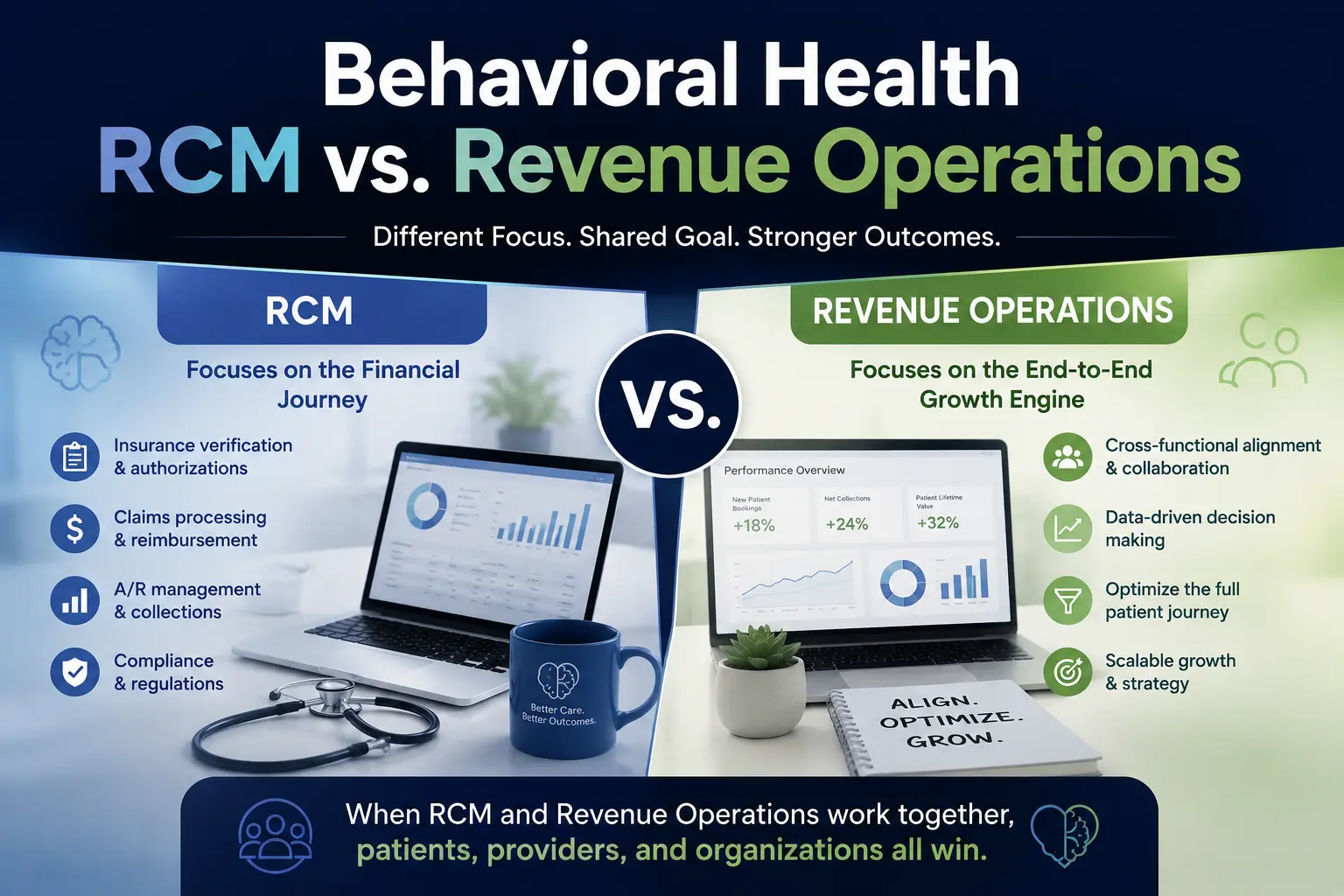
TL;DR: Behavioral health RCM is the transactional engine that converts delivered care into collected payment. It covers eligibility verification, coding, claim submission, denial work, posting, and follow-up. Revenue operations sits one layer above RCM. It shapes payer mix, pricing strategy, authorization priorities, intake rules, contract performance, and the KPIs leadership uses to make financial decisions.
RCM answers: Did we get paid for the service delivered?
Revenue operations answers: Was this the right service, payer, contract, and financial structure to begin with?
Both are required. RCM protects claim performance. Revenue operations protects the business model.
Behavioral health RCM and revenue operations are often used as if they mean the same thing. They do not. RCM is the transactional engine that helps turn a delivered service into a paid claim. Revenue operations is the strategic layer that determines whether the right services, payers, programs, and financial structures are being fed into that engine in the first place.
The difference matters because clinic leaders can improve clean claim rates, reduce obvious billing errors, and still have a cash flow problem. A facility can post a 95 percent clean claim rate and still lose financial ground if payer contracts are underperforming, intake rules are misaligned, authorization workflows are weak, or profitable-looking programs are draining margin behind the scenes.
Keep reading to learn about each function, determine the line between them, and find out how behavioral health RCM and revenue operations work together to create more predictable revenue.
What Behavioral Health RCM Actually Is
Behavioral health RCM is the end-to-end financial process that captures, manages, and collects patient service revenue. It is a defined sequence of steps. Each step has a measurable output. The discipline is operational excellence on transactions.
AHIMA breaks the revenue cycle into three phases:
- Front-end (registration, insurance verification, authorizations)
- Mid-cycle (coding, documentation, charge capture, utilization review)
- Back-end (claims, denials, reimbursement)
Behavioral health RCM follows the same shape but with specialty-specific complications: 42 CFR Part 2 documentation rules, MHPAEA parity requirements, ASAM medical necessity criteria, longer concurrent UR cycles for residential care, and state-specific Medicaid carve-outs.
When clinic operators ask whether their RCM is working, they are usually asking about clean claim rate, denial rate, and days in AR. Those are RCM metrics. They tell you whether the transactional engine is running.
What Revenue Operations Actually Is
Revenue operations is the strategic function that decides what the RCM engine should be running on in the first place. It is not a step in the cycle. It is the layer that designs the cycle, picks the inputs, and aligns the people who feed it.
A behavioral health RevOps function answers questions RCM cannot. Which payer contracts should we keep, which should we exit, which should we renegotiate. What is our optimal mix of commercial, Medicaid managed care, and self-pay. Which programs (PHP, IOP, OP, residential) are profitable on a per-claim basis after factoring in UR, length of stay, and denial rates. Which intake decisions are driving downstream revenue leakage. Which clinical documentation patterns are costing us appeals.
RevOps is cross-functional by design. It connects clinical leadership, admissions, billing, and finance into one strategic view.
RCM works inside the lane. RevOps designs the lane.
The Difference at a Glance
| Dimension | Behavioral Health RCM | Revenue Operations |
|---|---|---|
| Scope | Per-claim transaction lifecycle | Strategic financial design across the business |
| Time horizon | Daily, weekly, per-claim | Monthly, quarterly, contract-cycle |
| Primary KPIs | Clean claim rate, denial rate, days in AR, first-pass yield | Net revenue per admission, payer contribution margin, contract profitability, revenue per FTE |
| Owner | Billing manager / RCM director | CFO / VP Operations / executive leadership |
| Inputs to the other | Provides denial trend data, AR aging, payer behavior signals | Sets payer mix, pricing strategy, intake screening rules, program economics |
| Failure mode | Slow cash, high denials, AR creep | Profitable on paper, unsustainable in practice |
Why Behavioral Health Facilities Get Confused
In hospitals and large health systems, RCM and RevOps are usually separate departments with separate leadership. In behavioral health, they are almost always collapsed into a single function called “billing.” That collapse hides the strategic work entirely.
Three patterns show up repeatedly when the two functions are not separated:
1. The Billing Team Improves, But Cash Still Drags
Tactical wins, strategic losses. The billing team improves clean claim rate from 88 to 94 percent. Cash still arrives slowly because the underlying payer mix is loaded with high-denial commercial OON contracts that should have been renegotiated or exited a year ago. RCM did its job. RevOps was missing.
2. Payer Contracts Renew Without Margin Scrutiny
Reactive payer strategy. Contracts are renewed on autopilot because no one is running margin analysis at the contract level. The facility ends up with a portfolio that looks normal in aggregate and bleeds money on a per-program basis.
3. Admissions Accepts Patients the Revenue Cycle Cannot Support
Intake misaligned with billing reality. Admissions accepts patients whose insurance the billing team knows will deny 40 percent of claims. Without a RevOps view connecting the two, the same mistake repeats every quarter.
How RCM and Revenue Operations Should Hand Off to Each Other
The two functions only work when the data flows in both directions.
RCM Feeds RevOps With Pattern Data
Denial codes by payer, average days to payment by contract, appeal success rates by reason, AR aging by program. Without this data RevOps is making strategy from feel. With it, RevOps can model what would happen if a specific contract was exited or a specific intake rule was tightened.
RevOps Feeds RCM With Strategic Decisions
Which payers to prioritize at intake. Which authorization workflows to invest more staff in. Which programs deserve dedicated UR coverage. Which denials to systematically appeal versus accept. RCM teams operating without these decisions end up making them implicitly, one claim at a time.
Both Need Shared KPIs
Net collection rate, gross to net yield, and revenue per encounter sit at the boundary. They are produced by RCM but consumed by RevOps. A clean billing and claims management workflow is what makes those numbers trustworthy enough to drive strategic decisions in the first place.
What This Means for Behavioral Health Leaders
Three concrete shifts mark the transition from running RCM alone to running RCM plus RevOps:
- Separate the dashboards. RCM dashboards (clean claim rate, denial rate, days in AR) belong to billing leadership. RevOps dashboards (payer contribution margin, program profitability, revenue per encounter) belong to the executive team. Reviewing one set in the wrong room is how strategic problems get treated as tactical ones.
- Run quarterly contract reviews. Every payer contract should be evaluated on net contribution margin, denial rate, days to payment, and appeal effort. Contracts that lose money after RCM cost should be renegotiated or exited.
- Make intake a RevOps decision. Which insurance plans qualify for which programs is a strategic call, not an admissions desk one. RevOps sets the rules. RCM enforces them downstream.
For the formal definition and structural breakdown of the revenue cycle into front-end, mid-cycle, and back-end phases referenced above, see the AHIMA Revenue Cycle resource hub, which is the credentialing standard for HIM professionals.
Final Thoughts
Behavioral health organizations do not usually run into revenue problems because no one is working the claims. They run into revenue problems because billing is being asked to compensate for payer mix, contract terms, intake decisions, authorization strategy, and program economics it does not control.
Strong RCM matters. But RCM alone cannot fix a revenue model that was never designed strategically.
Work With CodeMax
CodeMax has spent more than 10 years operating both layers for behavioral health clients: RCM as the engine that gets claims paid, and revenue operations as the strategic layer that determines which claims are worth pursuing in the first place. If your team is running one without the other, the gap often shows up first in the contracts that should have been renegotiated months ago. Talk to CodeMax consulting to map your current state, or call 866-CODEMAX.
No. Medical billing is one stage of revenue cycle management. RCM covers the full transaction lifecycle from eligibility verification and coding through claim submission, denial work, and posting. Billing is the claim submission step inside that broader process.
Revenue cycle management is sometimes called RCM, healthcare revenue cycle, or patient financial services. Revenue operations is a related but distinct function that sits above RCM and focuses on financial strategy rather than transactional work.
Healthcare revenue cycle management is the end-to-end financial process clinics use to convert delivered services into collected payments. It includes eligibility verification, authorizations, coding, claim submission, denial management, and patient billing across front-end, mid-cycle, and back-end phases.
Behavioral health facilities outsource RCM when in-house teams cannot keep pace with payer rule changes, denial volume, or specialty coding requirements. The decision is RevOps, not just billing. Outsourcing makes sense when the outside team raises net collection without raising total cost to collect.
RCM handles the per-claim transaction. Revenue operations sets the strategy. RCM measures clean claim rate, denial rate, and days in AR. RevOps measures payer contribution margin, program profitability, and net revenue per admission. Both are required for stable cash flow.