TL;DR:
- What POS 10 and POS 02 actually mean, and why the one-digit difference changes the reimbursement rate
- The CMS rule change that settled how POS 10 gets paid, and when it took effect
- Modifier 95 vs. 93 vs. GT, and why the modifier doesn’t set the payment rate, the POS code does
- The POS-modifier mismatch that triggers denials
- Why this code draws extra attention in post-payment audits, especially for behavioral health
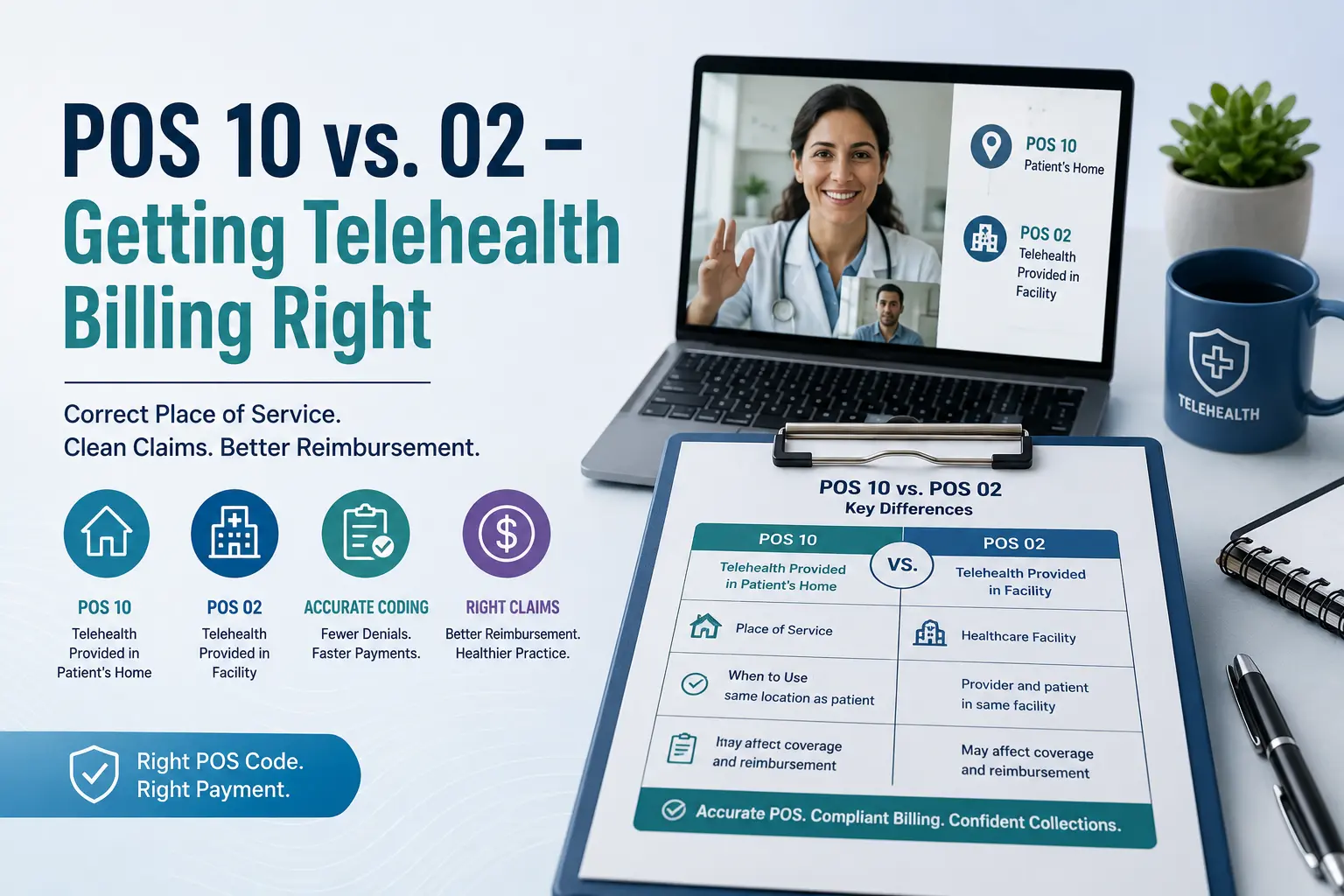
POS 10 means the patient received telehealth care at home. POS 02 means the patient was somewhere else, a clinic, office, or other remote site. Per CMS, POS 10 pays the non-facility rate; POS 02 pays the facility rate, which runs roughly 10 to 25% lower. Getting the code wrong doesn’t just risk a denial, it can mean getting paid the wrong amount on a claim that otherwise sails through.
What POS 10 and POS 02 Actually Mean
Per the CMS Place of Service Code Set, last modified February 17, 2026, POS 10 is defined specifically as telehealth provided in the patient’s home, permanent or temporary residence. It covers nothing else, not a clinic, not a skilled nursing facility, not an emergency room. POS 02 covers telehealth provided anywhere other than the patient’s home, an office, a school, or another remote site.
POS 10 wasn’t always this simple. CMS made it official on January 1, 2022, with billing effective April 1, 2022. For a couple of years after that, how POS 10 actually got reimbursed was less settled than the code’s definition suggested.
The CMS Rule Change That Settled the Reimbursement Question
The reimbursement gap between the two codes is the whole reason this matters, and it was formally locked in more recently than most billing teams realize. CMS Change Request 13582 instructed Medicare Administrative Contractors that telehealth claims billed with POS 10, when payable by Medicare, are to be paid at the Medicare Physician Fee Schedule non-facility rate, the same rate as an in-office visit. This was effective for dates of service on or after January 1, 2024, and implemented July 8, 2024.
POS 02 pays at the facility rate, which runs an estimated 10 to 25% lower. That means billing the wrong code doesn’t just risk a denial, it can mean getting paid the wrong amount for a claim that otherwise processes cleanly, easy to miss until someone compares billed codes against actual session locations months later.
Modifier 95 vs. 93 vs. GT: The Other Half of the Equation
POS tells a payer where the patient was. The modifier tells a payer how the service was delivered, and it does not change the reimbursement rate. The POS code alone determines whether a claim pays at the facility or non-facility rate.
Modifier 95 confirms a session happened over synchronous audio-video technology, and it’s what most commercial payers expect for video telehealth in 2026. Modifier 93 applies to audio-only sessions, which Medicare now covers permanently. Modifier GT still shows up as a payer-specific requirement in some commercial contracts, even though most have moved to 95, which is why checking a specific payer’s current policy matters more than assuming one modifier fits every claim.
The Mismatch That Triggers Denials
Payers increasingly cross-reference POS against the modifier automatically. Billing POS 10 without a modifier that confirms how the service was delivered creates a contradiction in the payer’s system: the code says the patient was at home, but nothing confirms a telehealth encounter took place at all, versus, say, an in-person visit billed incorrectly. That mismatch typically produces a denial requiring a manual appeal rather than a quick resubmission.
| Scenario | Correct POS | Modifier |
|---|---|---|
| Patient at home, video session | 10 | 95 |
| Patient at home, audio-only session | 10 | 93 |
| Patient at a clinic or remote site, video session | 02 | 95 |
| Payer-specific contract still requiring the older modifier | 10 or 02, per location | GT |
Why This Code Draws Extra Audit Attention, Especially in Behavioral Health
Because the reimbursement gap between POS 10 and POS 02 is real money, a pattern of POS 10 use that doesn’t match documented session locations is exactly what a post-payment audit looks for. This applies to any specialty, but it lands harder in behavioral health, where telehealth makes up a larger share of total visit volume than in general medical practice, so the exposure from a systemic POS error compounds faster across more claims.
Final Thoughts
POS 10 vs. 02 looks like a formatting detail, and it gets treated that way right up until a claim comes back denied or an audit turns up a pattern nobody meant to create. Confirming session location against the code billed, and confirming which modifier a specific payer actually requires, prevents both problems with the same check.
See how CodeMax handles claims accuracy across every billing scenario →
Frequently Asked Questions
The non-facility rate for POS 10 was formally set by CMS Change Request 13582, effective for dates of service on or after January 1, 2024, and implemented July 8, 2024. Before that, POS 10 existed as a code but its payment treatment wasn't governed by this specific rule.
Yes. Medicare covers audio-only behavioral health telehealth permanently, and those sessions use modifier 93 instead of 95, while the POS code still reflects whether the patient was at home (10) or elsewhere (02).
No. CMS requirements govern Medicare; commercial payers set their own policies, which is why some contracts still specify modifier GT even though most have moved to 95. Checking each payer's current telehealth policy is more reliable than assuming Medicare's rules apply everywhere.
It varies. Sometimes it produces an immediate denial from a POS-modifier mismatch. Other times the claim pays, just at the wrong rate, and isn't caught until a reimbursement review compares billed codes against actual session locations.
More often than most billing teams expect. CMS updated its Place of Service Code Set definitions as recently as February 2026, and the non-facility rate rule for POS 10 itself only took effect in 2024, which is why a periodic recheck matters even for a code billed correctly for years.