Key Takeaways: The year-end collections dip in behavioral health is predictable. Payer slowdowns, billing staff time off, tighter review, and timely filing deadlines all land in the same four to six weeks, and the work that protects Q4 revenue happens in October and November, not December.
- Payers run reduced staffing around the holidays, so claims, authorizations, and appeals all move more slowly.
- In-house billing teams take time off in the same weeks, which leaves denials unworked and follow-up calls unmade.
- Unresolved claims from earlier in the year approach their timely filing and appeal deadlines in Q4, and missed deadlines generally cannot be recovered.
- December cash pressure is when facilities accept low settlements or write off balances, which turns a timing problem into a permanent loss.
- Clean A/R, a cleared denial backlog, and planned holiday coverage going into December are what separate a short dip from a painful January.
Every year, a lot of behavioral health facilities see the same thing happen. Collections are steady through the fall, and then somewhere between Thanksgiving and the New Year, the cash slows down.
It is easy to read that as a bad month. It is usually something more predictable. Several things that affect revenue all happen in the same few weeks, and each one on its own would be manageable. Together they create a dip that shows up in January’s bank balance, long after the window to prevent it has closed.
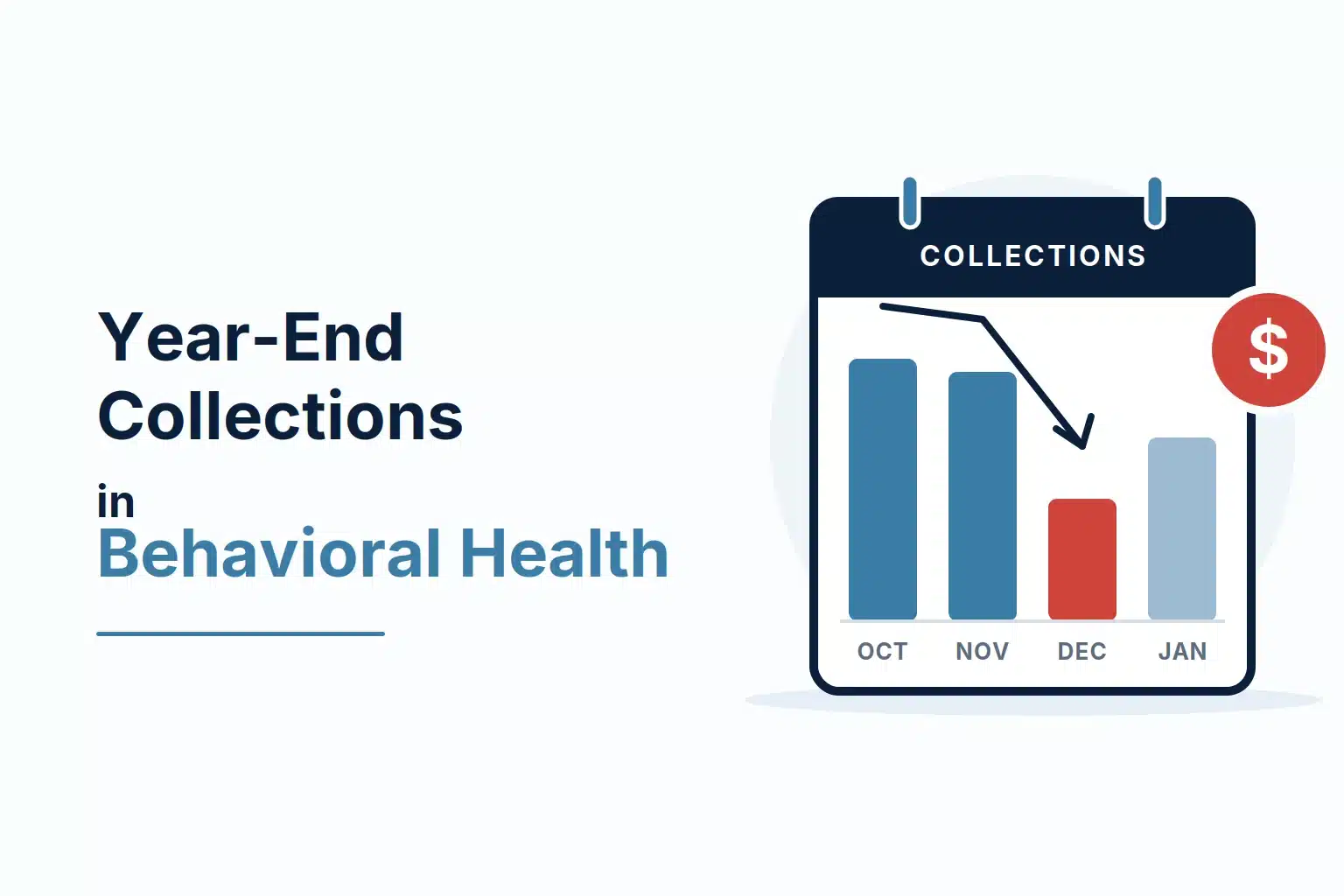
Behavioral health collections dip at year-end because payer holiday slowdowns, billing staff time off, tighter claim review, and approaching timely filing deadlines on older claims all arrive in the same four to six weeks. The dip is predictable, and almost all of it can be planned for in October and November.
What changes at year-end
- Payer processing slows around the holidays: Payers run reduced staffing around Thanksgiving, Christmas, and New Year’s, and claims processing, authorization reviews, and appeal responses all take longer. A claim that would normally pay in two weeks can take four. Nothing is wrong with the claim. The queue is simply moving slower.
- Facility billing teams take time off too: This is the part that compounds the first. The same weeks payers slow down are the weeks in-house billing staff take vacation. Denials sit unworked. Follow-up calls do not get made. Claims that needed a small correction wait until someone is back to fix them.
- Scrutiny tends to increase: Across the facilities we work with, we see a noticeable pattern of tighter review toward year-end: more records requests, more claims pended for additional documentation, and slower movement on anything that needs a second look. We are describing what we observe, not speculating about why payers do it. The practical effect is the same either way. Claims that need documentation take longer to resolve in December than they would in March.
- Timely filing deadlines catch up with old claims: Many payers set timely filing limits for corrected claims and appeals. Claims from earlier in the year that were never fully resolved start approaching those deadlines in Q4. If they are not worked before the window closes, they cannot be recovered at all.
None of these is unusual on its own. The problem is that they land in the same four to six weeks.
Why cash pressure makes it worse
There is a second effect that is easy to miss, and it is where year-end costs facilities the most money.
When cash is tight in December, the pressure to bring money in quickly goes up. That is when facilities are most likely to accept a lower settlement on a disputed claim than it is worth, write off a balance rather than pursue it, or stop appealing a denial because the appeal feels like it will take too long.
Each of those decisions can make sense in the moment. Added up, they turn a temporary timing problem into a permanent revenue loss. A claim that would have paid in full in February gets settled for less in December because the facility needed the money now.
The best protection is not to be in that position. A facility that goes into December with clean A/R, worked denials, and a clear view of what is owed is negotiating from strength. A facility that is surprised by the dip in the middle of it is not.

The year-end checklist
These are the steps that protect Q4 revenue. The earlier they start, the more they are worth.
- Work aged A/R before the holidays, not after: Go through everything over 60 and 90 days and decide what can be recovered, what needs a corrected claim, and what needs an appeal. Anything that waits until January is competing with the new year’s claims for attention.
- Clear the denial backlog: Every unworked denial is money sitting still. Prioritize by value and by deadline, and get appeals filed while payers are still processing at normal speed. Our piece on preventive denial management covers how to stop denials from building up in the first place.
- Check timely filing windows on older claims: Pull every open claim from earlier in the year and check its filing and appeal deadlines against the calendar. Anything close to the edge goes to the front of the line.
- Submit clean claims early in December: Claims submitted in the first two weeks of December have a better chance of being processed before holiday slowdowns fully set in. Claims submitted on December 22 are likely going into the slowest queue of the year.
- Get documentation ready for records requests: If scrutiny tightens at year-end, the facilities that respond fastest get paid fastest. Having clinical documentation complete and organized before it is requested removes days from every response.
- Plan billing coverage for the holidays: Decide ahead of time who is working denials, answering payer calls, and posting payments during the weeks staff are out. If the answer is nobody, that gap will show up in the numbers.
- Set collections expectations with leadership: A predictable dip is only alarming when it is a surprise. If leadership knows collections will slow in late December and recover in January, there is less pressure to make short-term decisions that cost money.
Who is working your claims over the holidays?
This is the question worth asking honestly in October.
For a facility with a small in-house billing team, holiday coverage is a real constraint. Two people covering billing means that when one takes a week off, half the capacity is gone, during the exact weeks the work is hardest. That is not a criticism of in-house teams. It is simply the math of a small team against a seasonal peak.
This is one of the reasons some facilities look at outsourced billing support. A larger team does not take a collective holiday, and coverage stays consistent through the weeks when consistency matters most.
Whether or not outsourcing is the right fit, the planning question is the same. Know who is covering what before December arrives.
See it coming instead of discovering it
The facilities that get through year-end without a painful January are usually not doing anything complicated. They can simply see what is happening in their revenue cycle as it happens, rather than finding out from a bank balance a month later.
That comes down to reporting. If you can see A/R aging, denial volume, and claims in process by payer at any point in the month, the year-end dip becomes something you manage rather than something that happens to you. Our piece on behavioral health financial reports covers what that visibility looks like in practice.
Final Thoughts
The year-end collections dip is predictable, which means it is manageable. Payer slowdowns, staff time off, tighter review, and filing deadlines all arrive in the same few weeks every year. None of them can be avoided. All of them can be prepared for.
The work that protects Q4 revenue happens in October and November. By the middle of December, most of the outcome has already been decided.
If you are not sure where your A/R stands going into the holidays, or who will be covering billing while your team is out, now is the time to find out.
Not sure where your A/R stands going into December? Request a revenue cycle audit to see what is recoverable before the holidays, or learn how our billing and claims management keeps coverage consistent while your team is out. Call 866-263-3629 or email info@codemaxmb.com.
You can also speak to a specialist about your year-end plan.
Frequently Asked Questions
Several things happen at once. Payers run reduced staffing around the holidays so processing slows, facility billing staff take time off, review tends to tighten toward year-end, and timely filing deadlines on older claims start to close. Each one alone is manageable. Together they slow cash flow in late December, and the effect usually shows up in January.
October and November. The most valuable work, clearing aged A/R, working the denial backlog, and checking timely filing windows, needs payers to be processing at normal speed. By mid-December, payer slowdowns make everything take longer and there is less time to recover anything that slips.
Payers generally do not close, but they do run reduced staffing around major holidays. Claims processing, authorization reviews, and appeal responses all tend to take longer during those weeks. Planning for slower turnaround in late December is more accurate than planning for a shutdown.
Generally, they cannot be recovered. Most payers set limits on how long after a date of service a claim, corrected claim, or appeal can be submitted, and those limits vary by payer and contract. That is why reviewing older open claims in Q4 matters. Claims from earlier in the year are the ones most likely to be approaching their deadlines.
It depends on the claim, but it is worth being careful. Cash pressure in December is when facilities are most likely to accept less than a claim is worth or write off a balance they could have recovered. A claim that would pay in full in February is often worth waiting for. Planning ahead reduces the pressure to make that trade.
Plan coverage before December. Decide who is working denials, handling payer calls, and posting payments during the weeks staff are out, and prioritize the highest-value and most time-sensitive claims before anyone leaves. For some facilities, outsourced billing support is a way to keep coverage consistent through the weeks when a small team is most stretched.