TL;DR – Behavioral health clinics rarely fail because of missing data. They fail because the reports they read are technically correct but operationally misleading. Gross revenue overstates earnings. Cash collections mix periods. A single net collection rate hides payer-specific bleeding. Census reports outpace AR aging. Standard AR buckets ignore contract underpayments. Reading these reports correctly is the difference between knowing your financial position and being surprised by it.
- Gross Revenue Is Not Income (And Most Dashboards Lead With It)
- Cash Collections by Month Mix Yesterday’s Work With Today’s
- A Single Net Collection Rate Hides Where the Bleeding Is
- High Census, Low Cash and the 60-Day Trap
- Standard AR Aging Buckets Ignore Contract Underpayments
- How Your Clinic’s Financial Reporting Stack Should Actually Look
Census looked strong through April. May closed clean, billing said the claims went out on time, and the dashboard at the leadership meeting showed a healthy month. Then July happened. Cash collections fell short of projections by a margin nobody had flagged. AR aging crept past sixty days with three payers. A back-of-envelope review of remits surfaced an underpayment pattern on a Marketplace plan that had been quietly running for two months.
This is not a story about a clinic with no visibility. This is a clinic with reports, with a billing team, and with a leadership cadence. It got surprised anyway.
Most behavioral health operators do not lack data. They lack a way to read the data they already have. The reports in front of them are technically correct and operationally misleading at the same time. Five of those reports come up most often.
Gross Revenue Is Not Income (And Most Dashboards Lead With It)
Gross revenue is the sum of what a clinic billed in a period. It includes the full charge rate before any payer adjustment, write-off, or contractual allowance. For most behavioral health operators, the number is large, prominent on the dashboard, and the first metric leadership sees in a monthly review.
It is also the most misleading number on the report.
The US national average for gross collection rate sits between forty and fifty percent across medical specialties. That is not a problem on its own. Contractual adjustments are normal. The problem is what happens when an operator reads gross revenue as performance. A residential program billing eight thousand dollars a day on the gross looks like a high-revenue business. The allowed amount under the contracted per-diem is a fraction of that. The clinic is not earning what the dashboard implies.
Behavioral health amplifies this gap. Residential, PHP, and IOP per-diems have large contractual write-downs across most commercial and Marketplace payers. The wider the gap between billed and allowed, the more deceptive the gross number becomes.
What to read instead: allowed revenue by month, contractual adjustment trend, and net revenue per day of care by level. These three together replace the gross dashboard with a number that tracks the business you actually operate.
Cash Collections by Month Mix Yesterday’s Work With Today’s
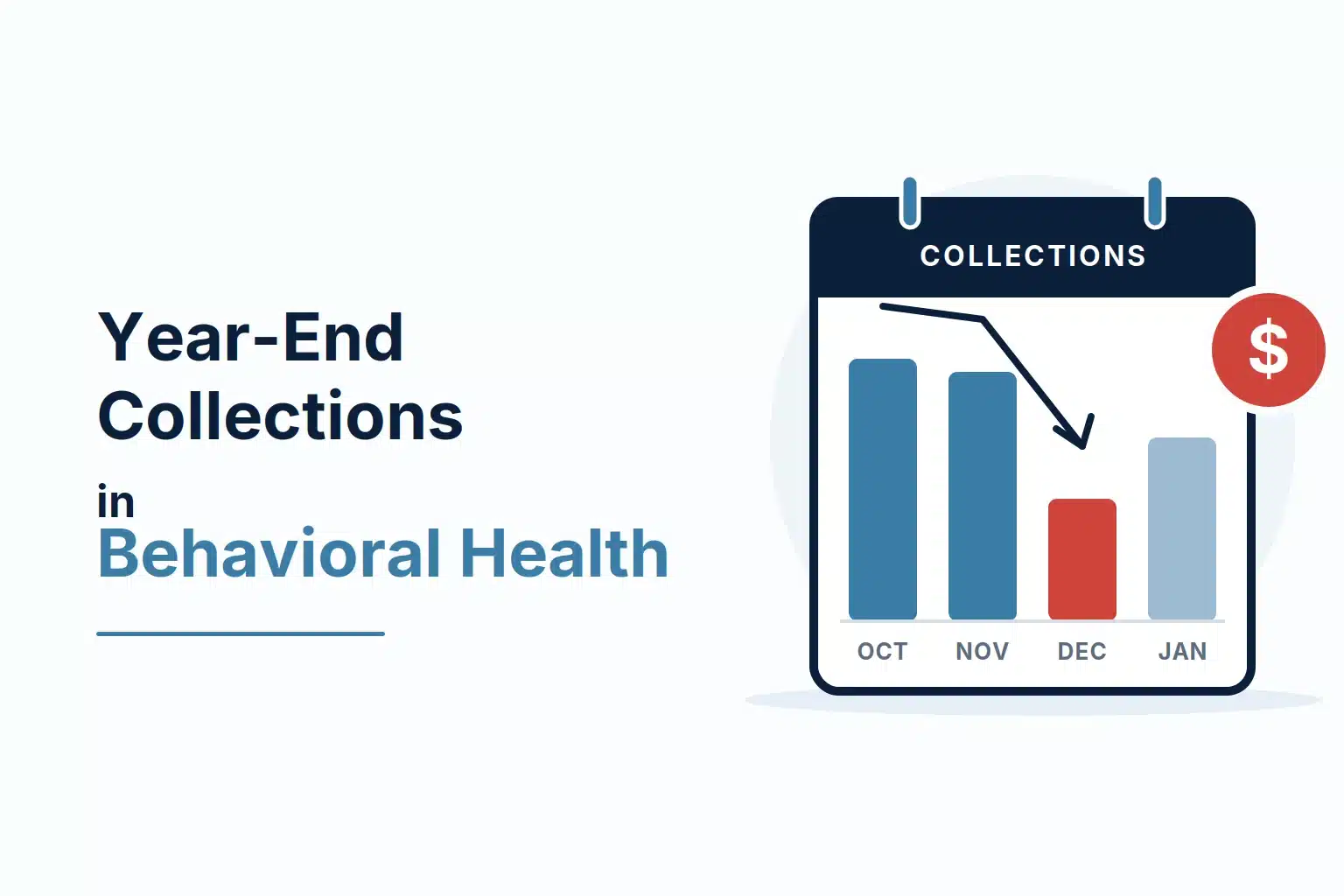
Cash collection reports show payments received in a given month. The reports are accurate. They are also two months stale in behavioral health.
A clean claim submitted in May enters a payer’s adjudication cycle, sits for thirty to sixty days depending on the payer, and lands as cash in late June or July. By the time the cash hits the bank, the clinical and billing operation that produced it has already moved through two more cycles. The October cash collection report is mostly August’s census and August’s claim submission discipline.
The trap shows up at quarterly reviews. A clinic celebrates a strong October cash month, attributes it to a recent operational change, and ramps marketing or staffing on the assumption that the trend will continue. November cash arrives soft. Leadership scrambles to find a cause in November when the cause was in September. The link between work performed and cash received is broken by a thirty to sixty day delay, and a cash-basis report cannot show that link.
What to read instead: accrual-basis revenue by date of service, claim submission velocity by week, and average claim-to-payment cycle time by payer. These three reports tie cash to the work that produced it.
A Single Net Collection Rate Hides Where the Bleeding Is
Net collection rate measures what a clinic actually collected against what it was contractually entitled to collect. The formula divides payments by allowed charges. Industry benchmarks from MGMA and AAFP set the healthy range at ninety-five to ninety-nine percent. Top performers run at ninety-eight to one hundred percent. The national average across specialties sits closer to eighty-eight percent.
Behavioral health practices face structural headwinds that make the 95% NCR benchmark harder to achieve than in primary care. Payer-mix variance is wider, parity disputes are more frequent, and authorization-driven denials are more common. An aggregate NCR that looks acceptable can hide a Marketplace line running at seventy percent while the employer commercial sits at ninety-nine.
A clinic at ninety-two percent NCR is two operationally different businesses, depending on the payer breakdown. If the commercial is at ninety-nine and a single Marketplace carrier is at seventy, the fix is targeted and tactical. If everything is hovering between eighty-five and ninety-five, the fix is systemic and slow. The single-number NCR cannot tell those two stories apart.
What to read instead: NCR by payer, NCR by level of care, and NCR trended over rolling twelve months. The single aggregate number is a summary, not a diagnostic.
High Census, Low Cash and the 60-Day Trap
Census reports refresh in real time. Cash reports lag by thirty to sixty days. AR aging reports lag further. The three reports describe the same business but operate on three different clocks.
The trap works like this. April census runs strong, leadership reads it as a leading indicator of good cash to come, admissions and marketing investment ramps in May. May census stays strong. Cash reports through May still reflect February and March activity. June cash arrives, and it is soft. Nobody connects the soft June cash to a billing or authorization problem from April because April felt like a strong month at the time.
MGMA benchmarks days in accounts receivable at under forty. Behavioral health clinics without active AR management routinely drift past sixty, and balances aging beyond ninety days collect at meaningfully lower rates. Read the census and the AR aging together. The disconnect between them is the leading indicator of cash pressure that has not arrived yet.
What to read instead: AR aging trended weekly, days-in-AR by payer, and a side-by-side of census versus claim submission rate versus cash collected for the same date-of-service window. The census-to-cash story is the one the reports rarely tell on their own.
Standard AR Aging Buckets Ignore Contract Underpayments
AR aging reports answer one question. What did the clinic bill, and what is still unpaid? The report sorts unpaid claims into thirty, sixty, ninety, and one-hundred-twenty day buckets. Operators use it to chase collections and triage payer follow-up.
The report does not answer a second question. What did the clinic bill, get paid on, and still get underpaid?
Underpayment happens when a payer reimburses a claim at a rate below the contracted fee schedule. The claim is closed. AR clears. The variance never appears on aging. Behavioral health is the most exposed specialty for this. Per-diem rates for IOP, PHP, and residential vary by payer, by contract version, and by level-of-care modifier. The arithmetic of catching underpayment requires a remittance audit against contract rates, not a glance at the aging report.
Industry data points to underpayment as a quiet revenue category. Behavioral health practices commonly lose ten to twenty percent of insurance revenue to structural issues that include modifier misalignment, level-of-care modifier errors, and contract rate variance that goes unchallenged.
What to read instead: payment-versus-contract variance by payer, remittance audit reports trended monthly, and recovery-eligible underpayment dollars as a tracked metric in the financial review.
How Your Clinic’s Financial Reporting Stack Should Actually Look
The five issues above share a pattern. Each report is correct on its face and incomplete in operational use. Reading the stack as a whole, on the right cadence, is what closes the gap.
A working behavioral health reporting stack includes six reports an operator should be able to pull on demand:
- Accrual revenue by month, tied to date of service
- Net collection rate by payer, trended monthly
- AR aging by payer, trended weekly
- Days-in-AR by payer
- Denial rate by payer and reason code
- Underpayment variance by payer
Cadence matters as much as the metrics. AR aging and denials reviewed weekly. NCR and accrual revenue reviewed monthly. Underpayment variance and contract performance reviewed quarterly. A monthly review of weekly-moving numbers misses the inflection points. A quarterly review of monthly-moving numbers turns a fixable trend into an entrenched problem.
None of this requires new technology. Most clinics already generate every report on the list. The gap is which reports get read, in what order, against what benchmark, and at what frequency. That operational discipline that holds a behavioral health revenue cycle together is what separates a reporting stack from a reporting habit.
Final Thoughts
Clinics get surprised because the reports they read confirm the wrong story. Gross revenue confirms strength that net revenue contradicts. Cash collection confirms a good month that accrual data calls a weak one. A single NCR confirms acceptable performance while a payer-level breakdown shows where the loss is concentrated. Census confirms growth that AR aging will reverse. Aging confirms collection that contract variance will undercut.
Reading financial performance correctly in behavioral health is a literacy problem before it is a technology problem or a staffing problem. The reports are commodity. The discipline to read them in the right order, at the right cadence, against the right benchmark is not.
CodeMax
For behavioral health operators rebuilding the reporting discipline that keeps a revenue cycle accountable to its own data, CodeMax provides the billing infrastructure and reporting depth that supports it. Explore CodeMax Billing & Claims Management.
Frequently Asked Questions
Gross collection rate is total payments divided by total billed charges. Net collection rate is total payments divided by allowed charges, which is the billed amount minus contractual adjustments. Net is the operationally meaningful number. Gross routinely sits in the forty to fifty percent range and tells you almost nothing about billing performance.
MGMA and AAFP benchmarks set ninety-five to ninety-nine percent as the healthy range, with top performers at ninety-eight to one hundred percent. The national average across specialties sits near eighty-eight percent. Behavioral health practices face structural headwinds that make ninety-five percent harder to reach than primary care.
MGMA benchmarks days in accounts receivable at under forty. Clinics without active AR management routinely drift past sixty. AR balances aging past ninety days collect at significantly lower rates and represent revenue at high risk of being written off.
Contract underpayment happens when a payer reimburses below the rate specified in the contracted fee schedule. The claim shows as paid and the AR clears. Standard aging reports never flag the variance because they only track billed-versus-paid, not contracted-versus-paid. Catching underpayment requires a remittance audit against contract rates.
AR aging and denials weekly. Net collection rate and accrual revenue monthly. Underpayment variance and contract performance quarterly. The cadence matters as much as the metrics. A monthly review of weekly-moving numbers misses the inflection points.