TL;DR: Florida rehab admissions slow down because patient inbound volume outpaces eligibility verification capacity, out-of-state plans require additional behavioral health carve-out checks, and most facilities still run eligibility verification sequentially instead of in parallel with clinical assessment.
Patients in active substance use crisis rarely wait 48 hours for a benefits check. When eligibility verification delays cause drop-off, the lost revenue is real but often invisible because no claim is ever created.
The fix is a faster admissions workflow: run benefit verification and clinical assessment in parallel, build payer-specific scripts, track drop-off by benefit verification stage, and measure time-to-admit alongside census.
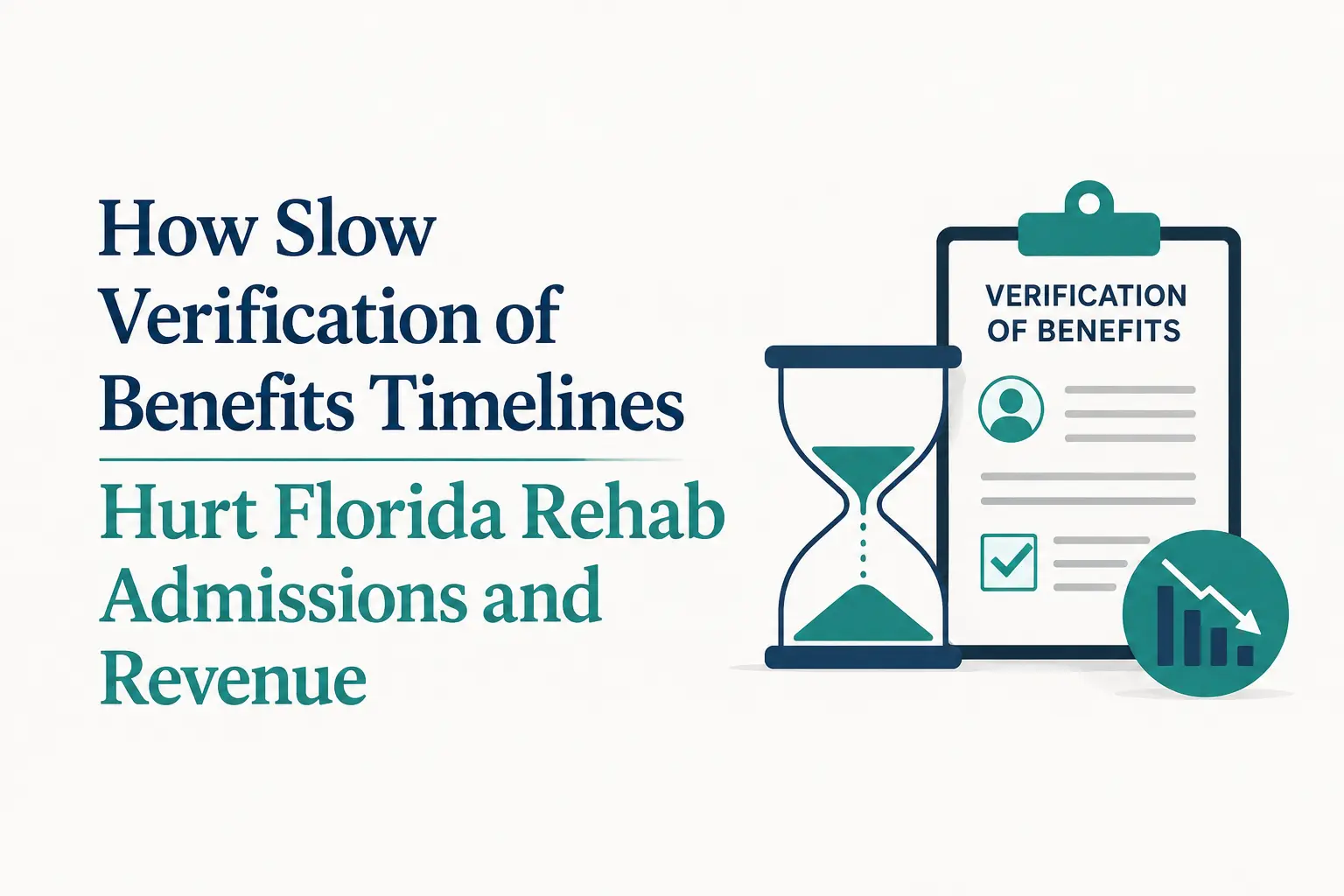
In Florida rehabs, admission speed matters. A patient may call on Tuesday ready to admit, but if the verification of benefits doesn’t clear until Thursday, they may choose another facility, lose momentum, or never return.
The lost admission never appears on a denial report. There is no claim, no AR entry, and no obvious billing failure. But the revenue loss is real.
That is why the rehab admissions process depends so heavily on benefit verification speed. In a high-volume Florida market with out-of-state plans, behavioral health carve-outs, and urgent patient decision windows, slow verification can become one of the most expensive bottlenecks in the admissions cycle.
Why Florida Rehab Admissions Run Differently
Florida rehab is a national-scope market operating inside a state regulatory structure. Three factors set the operational baseline:
Patient Origin Diversity
Florida facilities admit patients from all 50 states. A typical week brings BCBS plans from a dozen different state Blues, regional commercial plans, employer self-funded plans, and out-of-state Medicaid. Each plan has its own behavioral health vendor, prior auth requirements, and out-of-network rules. Eligibility verification complexity per admission is structurally higher than a state where most patients carry local coverage.
Volume Concentration
Florida has hundreds of DCF-licensed substance use disorder facilities under Chapter 397, plus AHCA-licensed mental health programs under Chapter 394. The market is dense. When a family calls multiple facilities the same day, the first eligibility verification to come back wins the admission.
Time-Sensitive Patient State
Substance use admissions are decision-window events. A patient in withdrawal, a family member who just lost their nerve, an interventionist running a clock. Once the window closes the admission is gone, often forever. Florida operators know this; the operational model has not always caught up.
Where the Eligibility Verification Time Actually Goes
A clean eligibility verification on a single-payer in-state commercial plan can return in 30 minutes. The Florida average is closer to 24 to 48 hours because of compounding delay sources, not one big bottleneck.
1. Behavioral Health Carve-Out Identification
Many out-of-state plans carve behavioral health out to a separate vendor (Carelon, Magellan, Optum Behavioral). The intake team verifies the medical plan, gets active status, and then has to re-verify with the behavioral health vendor. If the second call only happens after the first call closes, that is a half-day already gone.
2. Out-of-Network Rules and Single-Case Agreements
A meaningful share of Florida admissions are out-of-network. OON benefits require a different verification path: deductible status, coinsurance levels, prior auth requirements, and increasingly the question of whether the plan will entertain a single-case agreement. SCA conversations alone can take a day or more if the payer’s out-of-network team is slow to respond.
3. ASAM Level of Care Documentation
Many payers will not commit to coverage until the facility submits the proposed ASAM level of care along with clinical justification. If the clinical assessment runs sequentially after the financial verification, the payer’s 24-hour clock for prior auth response does not even start until the assessment is complete. Sequential workflows turn a 24-hour payer turnaround into a 48-hour total.
4. Phone Tree and Hold Time
Benefit verification calls happen by phone for most behavioral health vendors. Hold times can easily exceed 30 minutes per payer, especially when teams are routed through behavioral health vendors or out-of-network departments. A Florida intake team verifying three to six new patients in a day, each with their own payer route, hits hour-after-hour of hold time before any productive work begins.
Sequential vs Parallel Benefit Verification Workflow
| Step | Sequential (typical) | Parallel (faster admissions) |
|---|---|---|
| Initial intake call | Hour 0 | Hour 0 |
| Medical plan verification | Hour 0 to 4 | Hour 0 to 2 (one team) |
| Behavioral health vendor verification | Hour 4 to 12 (after medical) | Hour 0 to 2 (parallel team) |
| ASAM clinical assessment | Hour 12 to 18 (after benefit verification) | Hour 0 to 2 (parallel clinical team) |
| Prior auth submission | Hour 18+ | Hour 2 to 4 |
| Authorization decision | Hour 36 to 48 | Hour 12 to 24 |
| Patient drop-off risk | High | Low |
How Benefit Verification Delay Converts to Lost Revenue
Lost admissions do not appear on standard reports. The patient called, the patient did not admit, the file closed. There is no claim, no denial, no AR entry. The revenue impact is real but invisible.
The math gets concrete fast. A Florida residential facility with average reimbursement of $15,000 per admission loses $15,000 every time a patient drops off during the benefit verification window. A 10 percent drop-off rate on 200 inbound calls per month means 20 lost admissions, $300,000 in monthly revenue that never enters the cycle. Aggregate census reports do not surface this. Time-to-admit reports do.
What Florida Operators Should Be Measuring and Fixing
Run Benefit Verification and Clinical Assessment in Parallel
The single biggest gain is structural: the medical plan check, the behavioral health vendor check, and the ASAM clinical assessment can all run at the same time. They are independent until the prior auth submission step. A verification of benefits workflow that splits these tasks across parallel team members compresses 24 to 48 hours into 4 to 6.
Build Payer-Specific Scripts
Florida facilities see the same 30 to 50 payers over and over. Build a script for each one that captures every required data point on the first call, including behavioral health vendor identification, OON rules, ASAM threshold, and SCA contact. The phone hours are unchanged but the productive output per hour climbs.
Measure Time-to-Admit as a Primary KPI
Census, occupancy, and AR are lagging indicators. Time-to-admit is the leading indicator. Track median hours from intake call to admission across the past 30 days. Break it down by payer, by referral source, and by clinical severity. The patterns that emerge will point at the specific bottleneck the next workflow fix should address.
Track Drop-Off by Benefit Verification Stage
A patient who drops off after the medical verification is a different problem than a patient who drops off after waiting on the SCA decision. Tag each lost admission with the stage at which it stopped. Patterns in the drop-off stage point to the specific operational fix that would have saved that revenue.
For the broader admissions data context referenced throughout, including the substance use treatment volumes Florida processes annually, the SAMHSA Treatment Episode Data Set hub is the authoritative source for state-by-state admissions and discharges from licensed substance use treatment services.
Final Thoughts
Florida rehab admissions are window-driven. The patient decision window often closes faster than the workflow built to support it. Operators who treat eligibility verification as a back-office task risk losing admissions before billing ever begins. Operators who treat eligibility verification as the front line of revenue can move faster, reduce drop-off, and protect census.
Work With CodeMax
CodeMax combines decades of Florida behavioral health billing and revenue cycle management expertise with an RCM software platform built to make admissions, eligibility verification, claims, and revenue visibility faster. If slow benefit verifications are creating admissions drop-off, CodeMax helps operators streamline verification workflows, track key revenue cycle data in real time, and move patients from intake to admission with fewer delays. Contact CodeMax about your billing and RCM workflow, or call 866-CODEMAX today.
The rehab admissions process is the workflow from initial patient call through clinical assessment, insurance verification, prior authorization, and physical admission. In Florida, the process typically involves verification of behavioral health vendor coverage, ASAM level of care assessment, and prior auth before a patient can admit.
Verification of benefits is the process of confirming a patient's insurance coverage for behavioral health treatment. It includes plan active status, behavioral health vendor identification, deductible and coinsurance levels, in-network or out-of-network status, prior authorization requirements, and ASAM level of care thresholds.
Industry average runs 24 to 48 hours for behavioral health benefit verification. Sequential workflows take longer; parallel workflows can compress the cycle to 4 to 6 hours. The variation depends on payer behavioral health carve-out, OON rules, and whether ASAM clinical assessment runs in parallel.
Florida admits patients from all 50 states, which means each admission requires more payer-specific verification work than facilities in single-state markets. Out-of-state plans, behavioral health vendor carve-outs, and out-of-network rules compound the verification timeline beyond what local-coverage facilities encounter.
A behavioral health benefit verification should show plan effective status, behavioral health vendor (Carelon, Magellan, Optum, etc.), in-network and out-of-network deductible, coinsurance, copay, prior authorization requirements, ASAM level of care thresholds, and lifetime or annual benefit limits. Anything missing creates downstream denial risk.