TL;DR – Manual billing in behavioral health quietly costs more than most operators budget for. AMA data shows practices spend thirteen hours per physician per week on prior authorizations, and behavioral health carries the heaviest authorization load of any specialty. A single in-house biller cannot keep up with residential, PHP, IOP, and outpatient billing simultaneously. The real cost shows up as lost clinical hours, dropped admissions calls, slower claim submission, and delayed cash. The math gets worse as the facility grows.
At first, manual billing looks affordable. Hire one or two billers. Train the front desk to handle verifications. Have the admissions team chase prior authorizations. Let clinicians make the peer-to-peer calls when payers push back. The labor cost looks like the budget line and the system holds together if the volume stays small.
Then volume grows. Authorizations multiply. Denials stack. Payer hold times stretch. The single biller spends half the day on the phone. The front desk gets pulled away from intake calls to handle VOB. Clinicians lose treatment hours to peer-to-peer calls. The numbers on the spreadsheet still say one biller plus shared admin time. The actual cost is buried in everything else.
This is the quiet failure mode of manual billing in behavioral health. It is not that the billing breaks. It is that the rest of the operation slowly bends around the billing workload until clinical capacity, admissions throughput, and revenue cycle discipline all start absorbing the cost.
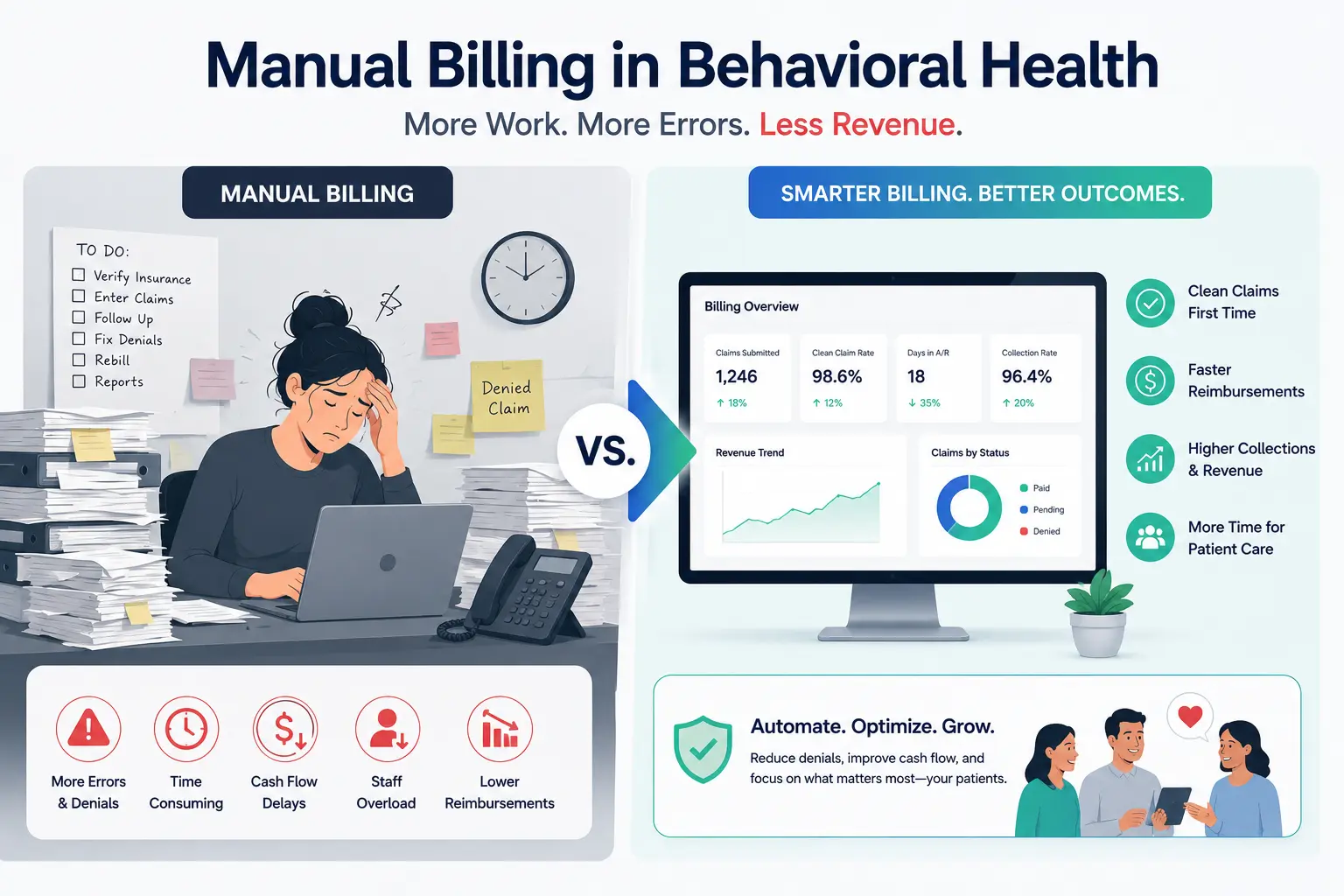
Manual billing fails in behavioral health because the workload is structurally heavier than other specialties. Prior authorizations are constant, payer hold times are long, and a single biller per facility cannot handle residential, PHP, IOP, and outpatient claims at scale. The hidden costs land on clinicians, front desk, and revenue rather than on the billing line alone.
The Staffing Math Most Clinics Underestimate
A medical billing specialist in the United States earns an average of $42,673 to $54,286 per year, depending on the salary source. Mental health billing specialists average $47,241. The wage looks straightforward. The fully loaded cost does not.
Healthcare employers typically carry an additional twenty-five to forty percent on top of base salary for payroll taxes, benefits, paid leave, training, and technology access. Applying a conservative thirty percent burden multiplier, a single mid-level mental health biller actually costs the facility between fifty-five thousand and sixty-five thousand dollars per year. Certified billers earn approximately twenty to twenty-seven percent more than non-certified billers, which pushes a fully loaded experienced biller into the seventy thousand dollar range.
That is one person. Behavioral health billing routinely requires more than one.
A facility running residential, PHP, IOP, and outpatient programs at moderate census needs separate workflows for each level of care. Each carries its own coding logic, authorization cycle, payer mix, and documentation requirements. A single biller cannot maintain rigorous follow-up on all four lines without something getting dropped. The realistic staffing picture for a multi-level-of-care facility looks closer to a billing lead, a claims specialist, an AR follow-up specialist, and an authorization specialist. Four roles, fully loaded, sit in the two-hundred-thousand to two-hundred-eighty-thousand dollar range per year.
The hiring side is its own problem. Behavioral health billing requires specialized knowledge that general medical billers do not have out of the box. ASAM criteria, level-of-care modifiers, parity-driven appeals, 42 CFR Part 2 handling, single-case agreement workflows, and per-diem reimbursement logic all sit outside standard medical billing curriculum. Recruiting takes longer. Onboarding takes longer. Turnover hurts more.
Clinicians Pulled Off Patient Care to Talk to Payers
The American Medical Association’s 2025 Prior Authorization Physician Survey found that practices complete forty prior authorization requests per physician per week and spend thirteen hours of physician and staff time managing those requests. Eighty-nine percent of physicians said prior authorization contributes to burnout. Eighty-eight percent said prior authorization increases overall healthcare utilization rather than reducing it.
Behavioral health carries the heaviest authorization load of any specialty. Behave Health, in its operator guide, names prior authorization as the single largest administrative burden in behavioral health billing. Residential and PHP claims require initial authorization, concurrent review at clinical milestones, and peer-to-peer escalation when payers push back. Telehealth has added another dimension. Therasoft tracked an eighty-four percent rise in telehealth-related claim denials in 2025, much of it driven by mismatches between authorized modality and delivered modality.
When the in-house billing team cannot handle the authorization volume, clinicians get pulled in. A licensed clinician on a peer-to-peer call with a utilization reviewer is sitting in a thirty to ninety minute meeting that should have been a clinical session. Multiply that across a week, across a clinical team, across a year, and the lost clinical hours become a serious cost.
Forty percent of physicians, per AMA data, have staff working exclusively on prior authorizations. For behavioral health facilities, the staff often is the clinician. That is the math problem manual billing solves by quietly transferring labor from billing infrastructure to clinical headcount.
Front Desk Buried in VOB Calls
Verification of benefits in behavioral health is not a quick eligibility check. A full VOB confirms active coverage, in-network or out-of-network status, deductibles, copays, out-of-pocket maximums, behavioral health benefit limits, day caps on residential treatment, prior authorization requirements, plan exclusions, and whether the plan carves out behavioral health benefits to a separate managed care organization.
A thorough VOB phone call with a major commercial payer commonly runs thirty to sixty minutes. Hold times are unpredictable. Information varies depending on which payer representative answers. Documentation has to be captured manually, including call reference numbers, time stamps, and notes that may need to be defended later in an appeal.
When the front desk handles VOB on top of intake calls, patient check-ins, scheduling, and admissions support, two things happen. Incoming calls get missed because the desk is on hold with a payer. And VOBs themselves get rushed, missing the detail that matters when a claim comes back denied two months later.
Admissions throughput depends on fast, complete VOB. When the front desk is buried in payer calls, admissions slow down, and admissions slowing down is a direct revenue problem.
The Hidden Cost Most Operators Miss
The visible cost of in-house billing is the salary line. The hidden costs are bigger.
When operators evaluate the true cost of manual billing, six categories add up faster than expected:
- Lost clinical hours from peer-to-peer calls and authorization work
- Dropped or delayed admissions when front desk is on hold with payers
- Delayed cash from slower claim submission and longer days in AR
- Higher denial rates and lower net collection rates from inconsistent follow-up
- Hiring, training, and turnover costs for specialized billing roles
- Compliance exposure when billing volume exceeds the team’s capacity to maintain documentation rigor
These costs do not show up on the billing department’s P&L line. They show up on the clinical side as burnout and reduced session availability. They show up on the admissions side as missed inquiries and slow conversions. They show up on the revenue side as longer AR and lower realized revenue. They are real costs, just not labeled correctly on most clinic financial reports.
The pattern looks like this when you map it out:
| Visible cost | Hidden cost most clinics miss |
|---|---|
| Biller salary | Fully loaded cost (taxes, benefits, training, tech) is 25-40 percent higher than base wage |
| One biller seems enough | Multi-level-of-care facilities need 3-4 specialized roles to function |
| Front desk handles VOB | Dropped admissions calls when front desk is on payer hold |
| Clinicians do peer-to-peers | Lost clinical hours that should have been treatment sessions |
| Claims go out eventually | Delayed cash, longer AR, lower net collection rates |
| Hiring solves capacity | Specialized BH billing knowledge is scarce, turnover hurts |
Why the Math Gets Worse As You Grow
Manual billing scales linearly. Patient volume scales faster. That gap is the structural reason in-house billing operations either stall growth or absorb the cost of growth through quality erosion.
A small facility at modest census can run on a single biller and a flexible front desk. The system holds. Add a second program, a second location, or a payer-mix shift toward more commercial complexity, and the workload jumps in a way that does not match the linear staffing model.
Three growth pressures hit at once.
Authorization volume multiplies. A new IOP program adds initial authorizations, concurrent reviews, and peer-to-peer escalations on top of the existing residential and PHP volume. The biller who could handle one stream cannot handle three.
Compliance overhead grows. Larger volume means more documentation, more risk analysis, more business associate management, more HIPAA and 42 CFR Part 2 exposure as records flow through more vendors and more workflows. The compliance discipline that worked at small scale starts breaking at larger scale.
The clinics that grow through this transition typically do one of two things. They build out a full in-house billing department with specialized roles, dedicated authorization staff, AR follow-up specialists, and compliance oversight, accepting the two-hundred-thousand-dollar-plus annual cost. Or they move to an outsourced revenue cycle partner whose infrastructure already handles the scaling problem.
What CodeMax Does Differently
CodeMax built its billing infrastructure specifically for behavioral health revenue operations. The platform handles residential, PHP, IOP, and outpatient billing with the level-of-care logic, ASAM-aligned documentation, payer-specific authorization workflows, and per-diem reimbursement structure that behavioral health requires.
The operational benefit translates into three things rehab operators actually feel.
Clinicians stay clinical. Authorization and peer-to-peer work moves into a specialized billing operation built for it, not onto the schedule of a licensed clinician who should be running treatment groups.
Front desk stays focused on patients and admissions. VOB and benefit verification move into a dedicated workflow with payer-specific protocols, not into the slot between intake calls.
Revenue cycle infrastructure scales without re-hiring. Adding a new program, a new location, or a new payer category does not trigger a hiring cycle. The infrastructure absorbs growth instead of breaking under it.
This is the operational discipline that holds a behavioral health revenue operation together, applied to the staffing question that manual billing keeps quietly answering wrong.
Final Thoughts
Manual billing in behavioral health is not cheap. It looks cheap on the salary line and quietly absorbs cost everywhere else: clinical hours, admissions throughput, days in AR, denial rates, and compliance exposure. The true cost compounds as the facility grows.
For behavioral health operators rethinking the in-house billing model and evaluating what revenue cycle infrastructure should actually look like at scale, CodeMax provides the billing platform, authorization workflows, and revenue cycle depth built specifically for behavioral health.
Explore CodeMax Billing & Claims ManagementFrequently Asked Questions
How much does it cost to hire an in-house behavioral health biller?
Base salary for a mental health billing specialist averages $47,241 per year. With benefits, taxes, training, and technology added, the fully loaded cost runs $55,000 to $65,000. Multi-level-of-care facilities typically need three to four specialized roles to function properly.
How much time do prior authorizations take in behavioral health?
The AMA’s 2025 survey reports practices spend approximately thirteen hours per physician per week on prior authorizations, completing about forty requests per week. Behavioral health carries the heaviest authorization load of any specialty due to residential, PHP, and IOP concurrent review cycles.
Why is verification of benefits harder in behavioral health than other specialties?
Behavioral health VOB requires confirming benefit-specific details like residential day caps, IOP and PHP coverage, separate behavioral health carve-outs, prior authorization requirements, and parity considerations. A thorough VOB call routinely runs thirty to sixty minutes, much longer than a routine medical eligibility check.
When should a behavioral health facility move from in-house billing to an outsourced partner?
Facilities outgrow manual billing when authorization volume, payer-mix complexity, or compliance overhead exceeds what a small in-house team can sustain. Common triggers include adding a second program, expanding into multi-payer commercial complexity, and AR days drifting past forty.
What happens to clinical capacity when clinicians have to do peer-to-peer calls?
Each peer-to-peer call runs thirty to ninety minutes with a utilization reviewer. Across a clinical team, the lost time accumulates quickly. Forty percent of physicians, per AMA data, have staff working exclusively on prior authorizations. In behavioral health, the staff is often a clinician.