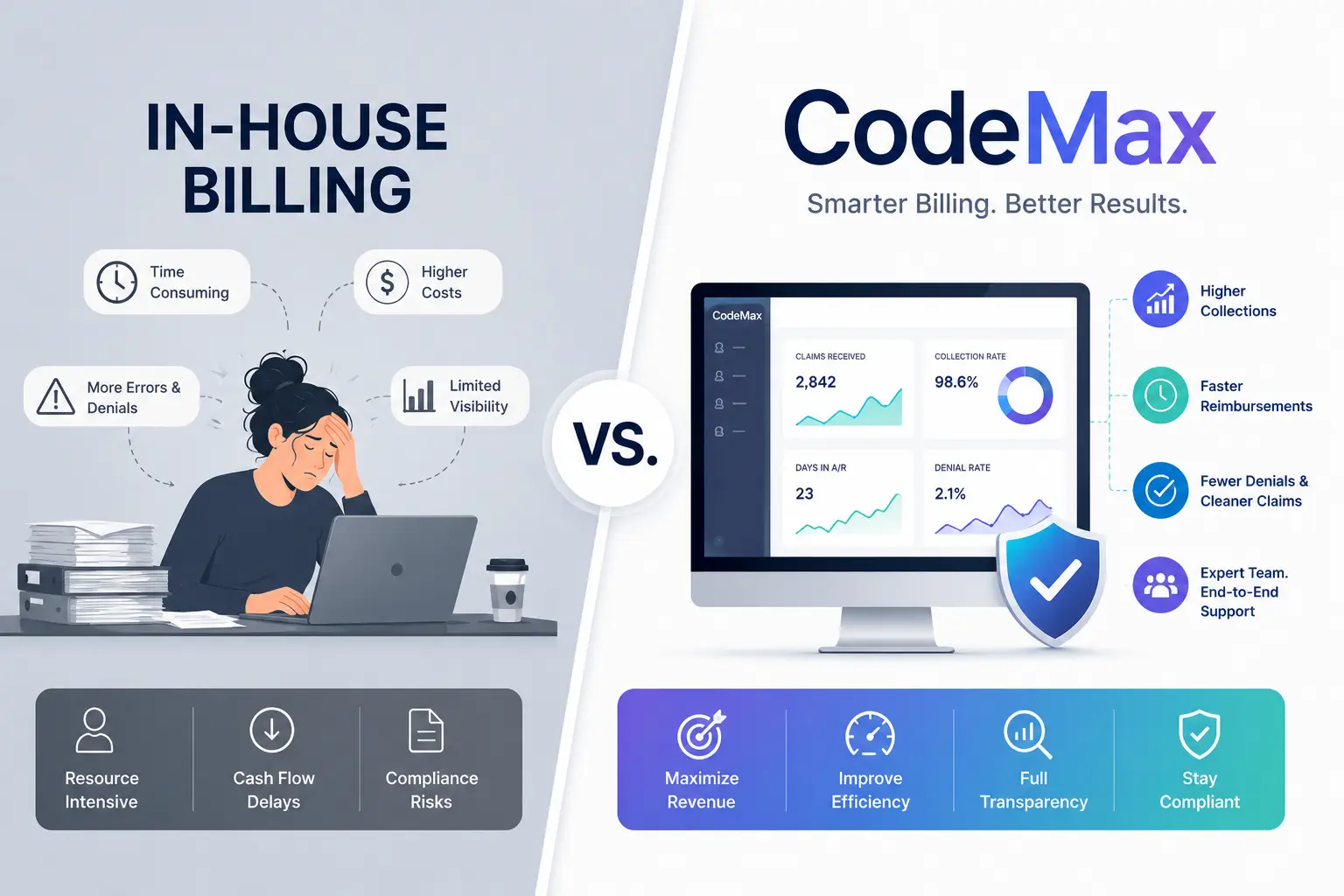
TL;DR – In-house billing in behavioral health pays out in five to six months on average. Outsourced behavioral health billing partners typically deliver cash in three months. The difference is not effort. It is infrastructure. Specialized partners run dedicated authorization, claim submission, denial management, and AR workflows that in-house teams cannot maintain at scale.
The decision to keep billing in-house or move it to a specialized partner usually gets framed as a cost question. It is not. The cost numbers matter, but they hide the operational gap that actually determines whether a behavioral health revenue cycle works.
The real comparison is between an in-house team handling whatever billing can fit into their week and a dedicated billing operation built specifically for behavioral health revenue. The two models look similar from a job-description perspective. The performance gap between them, measured in days to cash, clean claim rates, denial percentages, and AR aging, is what separates rehab clinics that grow predictably from clinics that scramble every month to find revenue they thought they had earned.
This blog walks through the comparison the way an operator should actually run it.
In-house billing in behavioral health pays out in five to six months on average. Outsourced behavioral health billing partners typically deliver cash in three months. The difference is not effort. It is infrastructure. Specialized partners run dedicated authorization, claim submission, denial management, and AR workflows that in-house teams cannot maintain at scale.
Getting Paid in Three Months Instead of Six
Cash timeline is the single biggest operational difference between in-house and specialized behavioral health billing. The benchmark numbers from current industry data are clear.
Outsourced behavioral health billing partners run accounts receivable cycles of approximately thirty to forty days. In-house billing teams, without dedicated authorization and AR specialists, routinely drift past sixty days and often run higher. MGMA’s industry benchmark for healthy AR sits at under forty. Clinics without active AR management commonly land in the sixty to ninety day range, with some balances aging past ninety days where collection rates drop significantly.
The practical translation is the difference between revenue earned in February showing up as cash in April versus showing up as cash in June or July. For a growing behavioral health facility, that gap is not a minor operational inconvenience. It is the difference between funding a new program from operating cash and funding it from a line of credit. It is the difference between competing for staff against well-capitalized regional groups and waiting on payments before making hiring decisions. It is the difference between weathering a soft month and panicking about it.
Faster cash also compounds. A clinic with a thirty-five day AR cycle has working capital available that a clinic with a sixty-five day AR cycle does not. That working capital pays for census fluctuations, payer disputes, expansion investments, and operational resilience. The gap between three months and six months to cash is not a billing metric. It is a strategic advantage.
Billing Is Far More Than Claim Submission
The framing that in-house billing means hiring a biller to send out claims is what gets clinics into trouble. Claim submission is one workflow among many.
The full behavioral health revenue cycle includes ten distinct operational layers that have to run together:
- Insurance verification and benefit confirmation before treatment begins
- Prior authorization initiation and tracking, with concurrent review cycles for residential and PHP
- Clinical documentation alignment so that progress notes support billed codes
- Coding accuracy across level-of-care modifiers, time-based codes, and telehealth place-of-service
- Claim scrubbing pre-submission to catch NCCI bundling conflicts and modifier errors
- Electronic claim submission through the right clearinghouse for each payer
- Electronic remittance advice posting and reconciliation against contract rates
- Denial management with structured appeals for medical necessity, parity, and authorization-driven denials
- Underpayment audit against payer contract rates to catch what aging reports never flag
- Compliance oversight covering HIPAA, 42 CFR Part 2, business associate agreements, and risk analysis
Submitting a clean claim represents one of those ten layers. A single in-house biller covers maybe four or five at a basic level. The other layers absorb attention from clinicians, front desk staff, and management who were hired to do other jobs.
This is what billing partners mean when they describe claim submission as the tip of the iceberg. The visible work is the claim itself. The structural work is everything that has to happen before, during, and after to make sure the claim pays at the right rate and on the right timeline.
In-House Teams Lack the Specialized Resources That Behavioral Health Requires
Behavioral health billing is not generic medical billing with a different specialty code. It is a different operational discipline.
The specialized resources that behavioral health billing actually requires include payer-by-payer authorization workflow protocols, ASAM criteria-aligned documentation templates, parity-driven appeal libraries, single-case agreement management, per-diem reimbursement reconciliation tools, level-of-care-specific clinical documentation checklists, 42 CFR Part 2-compliant data handling infrastructure, and continuous payer policy monitoring. These are not tools a single in-house biller assembles. They are the operational layer that a specialized billing operation builds and maintains as its full-time work.
A specialized billing partner spreads that hiring, training, retention, and replacement risk across an entire team rather than concentrating it on a single in-house role.
The Performance Gap, Measured
The performance differential between in-house and outsourced specialty billing shows up across every metric that translates to revenue.
| Metric | In-house team typical | Specialized outsourced partner |
|---|---|---|
| Clean claim rate | 80% to 90% | 92% to 98% |
| First-pass denial rate | 10% to 20% | 2% to 8% |
| Days in AR | 50 to 60+ days | 30 to 40 days |
| Net collection rate | 85% to 92% | 95% to 99% |
| Cash to clinic timeline | 5 to 6 months | 3 months |
| Coverage during staff absence | None | Full team redundancy |
| Specialty knowledge depth | Limited to current staff | Continuous across team |
A clinic running at the in-house end of these ranges versus the outsourced end of these ranges is leaving meaningful revenue on the table every month. The gap is not a few percentage points. It is the difference between a behavioral health facility that operates with cash flow predictability and one that does not.
The numbers also explain why outsourced billing, which is often priced as a percentage of collections in the four to ten percent range, is frequently cash flow positive from day one. The performance lift on collections usually outweighs the fee on a net basis, particularly for facilities that were running denial rates above ten percent or AR days past fifty.
When In-House Billing Actually Works
This is not a universal argument against in-house billing. There are scenarios where it works.
In-house billing tends to work well when four conditions are present at the same time. Annual collections are large enough to fund a fully-staffed specialty billing department, typically above five million dollars. Specialty knowledge already lives inside the organization at the management level, beyond what the staff alone can carry. Denial rates are already running below five percent and AR is already under thirty-five days. And the integration between clinical, admissions, and billing workflows is tight enough that the operational benefit of in-house exceeds the cost premium.
If all four conditions are present, in-house billing can match or exceed outsourced performance. Most behavioral health clinics do not have all four. The clinics that try to maintain in-house billing without all four end up absorbing the performance gap on the revenue side.
Why CodeMax
CodeMax built billing infrastructure specifically for behavioral health revenue operations. The platform handles residential, PHP, IOP, and outpatient billing with the level-of-care logic, ASAM-aligned documentation, payer-specific authorization workflows, and per-diem reimbursement structure that behavioral health requires.
Three operational benefits translate directly to rehab clinic performance.
Cash arrives faster. AR cycles compress from sixty-plus days toward the thirty-five day benchmark, which is the difference between funding operations from collections and funding them from credit.
Denial rates drop. Specialized authorization workflows, clinical documentation alignment, and pre-submission claim scrubbing catch the errors that drive in-house denial rates into the double digits.
Compliance and infrastructure scale with the clinic. Adding a new program, a new location, or a new payer category does not trigger a hiring cycle. The infrastructure absorbs growth instead of breaking under it.
This is the operational discipline that holds a behavioral health revenue operation together. CodeMax does not replace a biller. It replaces the entire revenue cycle infrastructure that in-house billing keeps quietly trying to be.
Final Thoughts
In-house billing and a specialized behavioral health billing partner are not the same job at different price points. They are different operational models. The cash timeline, denial rate, AR aging, and net collection rate gaps are real and measurable. For behavioral health operators, the question is not whether to hire a biller. The question is whether the billing infrastructure currently in place is the one the business actually needs.
For behavioral health operators comparing in-house billing performance against what a specialized partner can deliver, CodeMax provides the billing platform, authorization workflows, and revenue cycle infrastructure built specifically for behavioral health revenue operations.
Industry benchmark reference: AAFP practice management resource.
Frequently Asked Questions
How long does it take to get paid through outsourced behavioral health billing versus in-house?
Outsourced behavioral health billing partners typically run AR cycles of thirty to forty days. In-house teams without dedicated authorization and AR specialists routinely run sixty days or longer. The cash timeline difference is roughly three months for outsourced versus five to six months for in-house.
How is outsourced behavioral health billing priced?
Outsourced behavioral health billing is typically priced as a percentage of collections, generally four to ten percent depending on specialty complexity, level of care mix, and service scope. Fully loaded in-house billing for a multi-level-of-care facility usually exceeds the percentage-of-collections cost.
What metrics should I use to compare in-house vs outsourced billing?
Compare clean claim rate, first-pass denial rate, days in AR, net collection rate, and time-to-cash. In-house teams typically run 80-90% clean claim rates and 50-60+ day AR. Outsourced specialty partners typically run 92-98% clean claim rates and 30-40 day AR.
Is it cheaper to keep billing in-house?
Usually not. The true cost of in-house billing goes well beyond salary. Once you factor in benefits, training, turnover, and the revenue lost to denials and underpayments, most facilities find outsourcing pays for itself. Specialized billing partners also bring payer-specific expertise that is difficult and expensive to replicate internally.
When does in-house billing actually outperform outsourced billing?
In-house works when annual collections exceed five million dollars, specialty knowledge lives at the management level, current denial rates are under five percent, AR is under thirty-five days, and clinical/admissions/billing integration is already tight. Most behavioral health clinics do not have all four conditions.