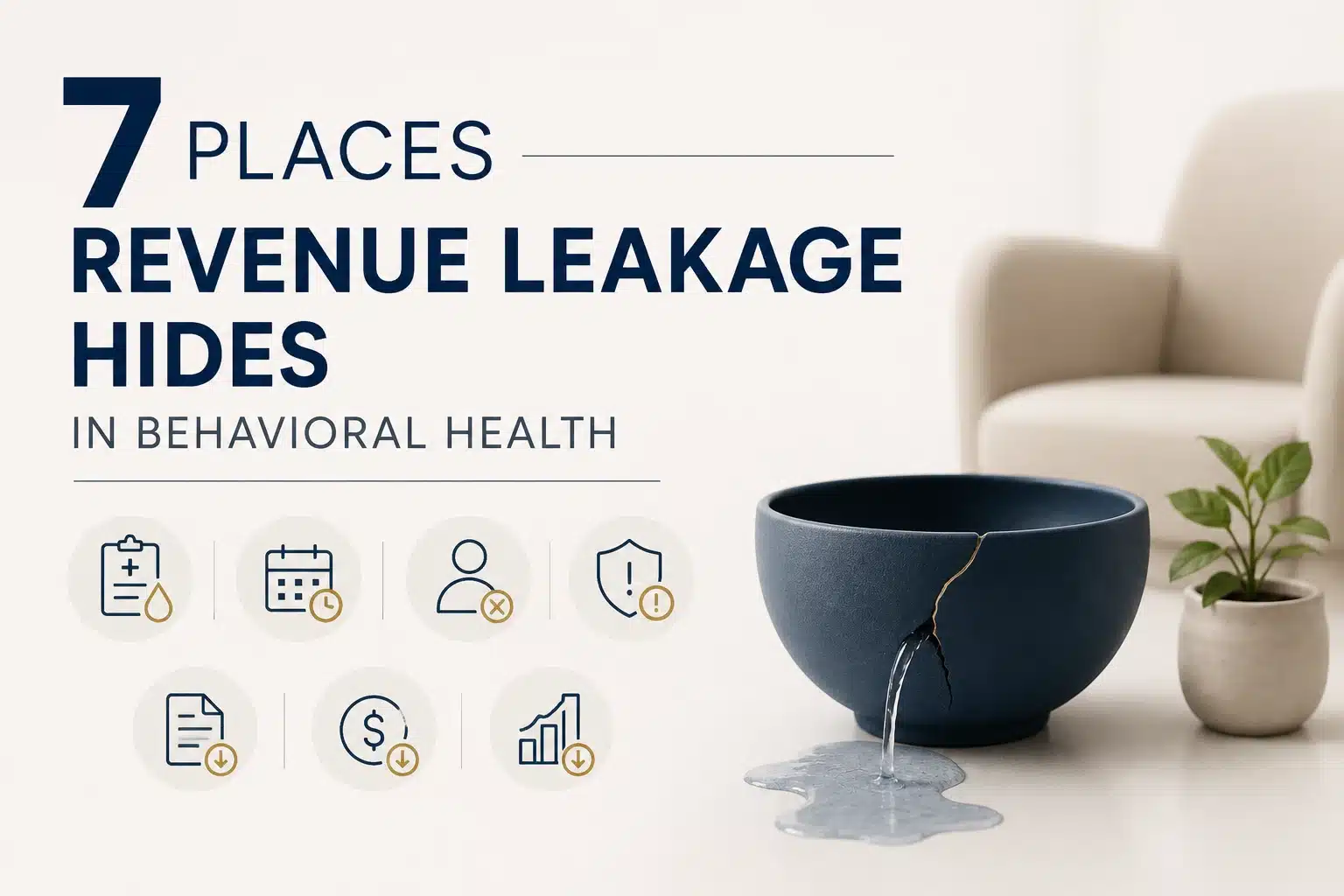
TL;DR: Behavioral health revenue leakage usually hides in seven places: eligibility verification gaps, authorizations that do not match the service delivered, undercoding, denials that age past timely filing windows, underpayments treated as final payments, services delivered outside the authorized stay window, and self-pay balances that age into write-off.
Aggregate AR dashboards often hide these problems because each leak belongs to a different team or workflow. The fix is to track each category separately, assign ownership, and review leakage as a cross-functional revenue cycle issue rather than a billing problem alone.
Revenue leakage is the gap between what a behavioral health facility earns for clinical work and what it actually collects. Most facilities know the number is not zero. Fewer know where the money is leaving.
That is what makes revenue leakage so difficult to fix. It rarely shows up as one obvious billing failure. It compounds across eligibility, authorizations, coding, denials, underpayments, utilization review, and patient balances. By the time leadership sees the problem in an AR report, the original leak may already be buried inside a rolled-up dashboard.
KFF’s analysis of HealthCare.gov insurers found a 19 percent in-network denial rate across Marketplace plans in 2024. Behavioral health facilities often face additional reimbursement pressure because medical necessity, authorizations, payer carve-outs, and level-of-care changes add more ways for earned revenue to fall out of the cycle.
This article maps the seven places revenue leakage happens in behavioral health billing, why each one is easy to miss, and where facilities should look first to stop preventable revenue loss.
What Revenue Leakage Means in Behavioral Health
Revenue leakage is any earned revenue that never converts to cash.
It is not the same as a denial. A denial is a single event. Leakage is the cumulative effect of denials, underpayments, write-offs, and uncollected balances over time. A facility can have a 92 percent clean claim rate and still leak 15 percent of net revenue because the leakage is happening in places that do not show up on the clean claim dashboard.
In behavioral health, leakage is structurally higher than general medical practice for three reasons: subjective medical necessity criteria for residential and PHP, frequent concurrent UR cycles, and payer mixes weighted toward managed Medicaid plans that deny at higher rates. Knowing the structural cause is not the same as knowing the operational source. The seven places below are the operational sources.
The 7 Places Revenue Leaks
1. Eligibility Verification That Stops at “Active”
A patient’s coverage shows as active. Intake clears them. Three weeks later, the claim is denied because the service was not covered under their plan.
The verification missed plan-specific behavioral health carve-outs, level-of-care exclusions, or a separate behavioral health vendor managing the benefit. Most billing teams treat eligibility as a yes/no question. In behavioral health it is a multi-layer question: is the plan active, does it cover this level of care, is the behavioral benefit carved out to a different payer, what authorization is required.
2. Authorizations That Do Not Match the Service Delivered
A facility gets approval for residential treatment. The clinical team steps the patient down to PHP after a week. The new level of care needs a new authorization. If admissions paperwork rolls forward without re-authorizing, the PHP days bill against an inactive auth and deny.
This leak is easy to miss because it may not look like a complex denial pattern. It may simply show up as a no-authorization claim, a payer dispute, or a write-off candidate. The underlying issue is not claim submission. It is the handoff between clinical care, utilization review, and billing.
3. Undercoding of Time and Complexity
Undercoding is one of the quietest revenue leaks because nothing technically “breaks.” The claim goes out. The payer processes it. Payment comes in. The account closes. But the service was billed at a lower level than what the clinical documentation supported.
In behavioral health, time-based and complexity-based codes can materially affect reimbursement. A longer therapy session, crisis service, family therapy component, or care coordination activity may support a different code or add-on code. If the documentation does not clearly separate that work, or if billing defaults to the simpler code, the clinic collects less than it earned.
No denial appears. No appeal is triggered. The missing revenue is never seen because the claim was paid.
4. Denials That Age Past the Timely Filing Window
Most payers have appeal windows of 90, 120, or 180 days. Denials sit in a queue. Staff turnover, holiday backlogs, or a single complex claim absorbing weeks of attention can push routine denials past the window. After the window closes, the claim is uncollectible regardless of merit.
A facility looking at total denial recovery rate will not see this; it shows up only when denial age is segmented by payer.
5. Underpayments Treated as Final Payments
A claim was approved at 60 percent of the contracted rate. Cash hit the account. The claim closes. No one compared the paid amount to the contract because the system marked it paid.
Out-of-network claims and UCR claims are particularly prone to this. Aggregate net collection rate hides per-claim underpayment patterns. The leak is not in denials; it is in claims that were paid less than they should have been and never appealed.
6. Services Rendered Outside the Authorized Stay Window
Concurrent UR runs in 5 to 7 day approval cycles. A patient is approved for 7 days. On day 8 the next review has not come back yet. Clinical care continues because that is what clinical care does. The day 8 service is delivered with no active authorization. When it bills, it denies.
This leak is not caused by carelessness. It is caused by the gap between clinical reality and payer authorization timing. Still, the financial impact is real. Facilities need daily visibility into days authorized versus days delivered so authorization gaps are caught before care turns into unpaid revenue.
7. Self-Pay Balances That Age Into Write-Off
Patient financial responsibility has grown across all of healthcare. In behavioral health, deductibles and coinsurance get billed to the patient after insurance clears. Without a structured patient billing workflow with statements, payment plans, and collections escalation, self-pay balances over 90 days collapse into write-off.
Facilities that have only ever managed insurance billing often run patient billing as an afterthought. The afterthought is where 3 to 8 percent of net revenue leaks out.
Where Each Leak Hides on Your Dashboard
| Leak | Why It Stays Hidden | Metric to Track Instead |
|---|---|---|
| Eligibility gaps | Counts as denial, not as intake error | Eligibility-related denial rate by payer |
| Auth mismatch | Logged as no-auth write-off | Level-of-care change tracking against active auth |
| Undercoding | No denial event, no signal | Code mix vs clinical service mix audit |
| Denials past filing | Aggregate denial rate looks fine | Denial age by payer with timely filing alerts |
| Underpayments | Marked paid in the system | Paid amount vs contracted rate variance |
| Out-of-window service | Generated by clinical workflow, not billing | Days delivered vs days authorized daily |
| Self-pay aging | Buried in the tail of AR | Self-pay AR aging buckets, separate from insurance |
Why Most Billing Teams Miss These
Behavioral health billing teams are not missing these leaks because of carelessness. Three structural reasons drive the misses:
- Aggregate dashboards reward rolled-up metrics. A 92 percent clean claim rate looks like success. The 8 percent that did not clean is where most of the leakage lives, and it gets averaged into invisibility.
- Ownership is unclear. Eligibility is intake. Authorizations are clinical UR. Coding is the coder. Denials are the biller. Underpayments are the contract reviewer, who often does not exist. Self-pay is sometimes outsourced to a different vendor entirely. No single person sees all seven leaks at once.
- Volume hides patterns. A 200-bed facility processes thousands of claims a month. A 4 percent leakage on undercoding is statistically obvious only when someone breaks code mix down by clinical service mix, which most teams never do.
Plugging these leaks is a quality assurance problem, not just a billing problem. The facilities that close the gap have a QA function that audits across these seven categories on a monthly cadence and reports the results to executive leadership.
Where to Start
Three moves recover the largest share of leakage in the shortest time:
- Run a 90-day denial age report by payer. Anything inside 30 days of timely filing window gets worked first. This recovers leak #4 immediately.
- Audit the last 100 closed claims against contracted rates. Variance over 5 percent flags leak #5. The patterns will point to a specific contract or payer.
- Pull a sample of clinical sessions and compare against the codes billed. Mismatches between session length, service complexity, and code billed flag leak #3. This is the quietest leak and usually the largest.
For the underlying denial rate context driving most of these leaks, the KFF analysis of ACA Marketplace claims denials in 2024 shows insurers denied 19 percent of in-network claims and 37 percent of out-of-network claims, with consumer appeals running below 1 percent. Behavioral health typically runs above those averages.
Final Thoughts
Revenue leakage is rarely one big problem. It is many small problems that add up. Facilities that treat leakage as a billing issue will keep finding the same number when they audit a year from now. Facilities that treat it as a cross-functional problem across intake, clinical, UR, coding, billing, contract review, and patient billing close the gap and stop reopening it.
Work With CodeMax
CodeMax has spent more than 10 years perfecting revenue leak prevention for behavioral health clients. Contact us to scope a leakage audit on your own AR, or call 866-CODEMAX.
Revenue leakage is earned revenue that never converts to cash. It includes denials that go unappealed, underpayments treated as final, services billed at lower complexity than delivered, and patient balances that age past collectability. It is cumulative, not a single event.
Compare expected revenue against collected revenue, then break the gap down by category: denial rate, denial age, underpayment variance, code-to-service mix, and self-pay aging. Aggregate dashboards hide leakage. Category-level dashboards expose it.
Assign ownership for each leakage category, audit code mix against clinical service mix monthly, run denial age reports by payer, compare paid amounts to contracted rates, and break self-pay aging out from insurance aging. Cross-functional ownership prevents most leakage.
In healthcare, revenue leakage is the gap between earned clinical revenue and collected cash. It comes from denied claims, underpayments, undercoding, services rendered outside authorization windows, and uncollected patient balances. KFF data shows 19 percent of in-network claims denied across ACA marketplace plans.
Start with a 90-day denial age report by payer, a contract variance audit on closed claims, and a code mix audit against clinical service records. These three reports surface the largest leaks within a single quarter. Sustainable prevention requires monthly QA across all seven categories.