TL;DR: The real cost gap between in-house and outsourced behavioral health billing shows up in denied and complex claims, not routine ones. This piece covers:
- Why routine claims aren’t where the money is won or lost
- What denials do to an in-house team’s staffing math
- What actually changes when billing moves to an outsourced partner
- A side-by-side look at where each model’s costs land
- The questions to ask before deciding
Routine claims cost about the same to process whether a clinic’s own biller submits them or an outsourced partner does. The real cost difference between in-house and outsourced billing shows up once claims stop being routine: when they get denied, get flagged for medical necessity review, or need an appeal. Behavioral health carries more of those claims than almost any other specialty, and that’s where this comparison actually needs to happen.
Behavioral health claims are denied on initial submission at rates of 20 to 30 percent, compared to roughly 5 to 10 percent for general medical claims, according to data reported by the Healthcare Financial Management Association. That gap is the entire reason a routine-claims cost comparison misses the point. A billing model that looks fine on paper for clean claims can still be losing significant revenue once a meaningful share of claims come back denied.
Why the Real Cost Comparison Isn’t About Routine Claims
A clean claim with correct coding, an active authorization, and no medical necessity questions costs roughly the same to submit whether it’s handled in-house or by an outsourced partner. Where the cost diverges is what happens after a claim gets denied. Someone has to identify the denial reason, pull the clinical documentation, determine whether it’s appealable, correct and resubmit or file a formal appeal, and follow up until the claim actually pays. None of that work scales the same way routine submissions do, and behavioral health generates far more of it than general medical practices because of the higher denial rate noted above.
That’s the comparison worth running: not “what does it cost to submit a claim,” but “what does it cost to keep a claim that’s already been denied from becoming a write-off.”
What Denials Do to In-House Staffing
CodeMax has covered the staffing math behind manual billing in detail in Why Manual Billing Fails in Behavioral Health, and the base numbers are worth repeating here because they anchor this comparison. A mental health billing specialist earns an average base salary of $47,241 a year. Once payroll taxes, benefits, training, and technology access are added at a conservative 25 to 40 percent burden, a single mid-level biller costs a facility $55,000 to $65,000 fully loaded. Certified billers, who typically earn 20 to 27 percent more, push that closer to $70,000.
That’s the cost of one person handling one workflow. A facility running residential, PHP, IOP, and outpatient programs at once needs separate authorization cycles, coding logic, and payer follow-up for each level of care, which is why a realistic in-house team for a multi-level-of-care facility runs closer to three or four specialized roles, in the $200,000 to $280,000 range annually. That’s before counting what happens when the denial rate climbs.
The Headcount Multiplier: A Realistic Staffing Model
Here’s the piece that doesn’t show up on a staffing spreadsheet. A biller’s capacity to handle new claims and a biller’s capacity to handle denied claims draw from the same hours in the same day. At a 5 to 10 percent denial rate, a billing team can usually absorb the rework without falling behind on new submissions. Above that, and moving toward the 20 to 30 percent range that behavioral health regularly sees, a growing share of every biller’s week goes to research, resubmission, and appeals instead of new claims.
No public benchmark states exactly how many additional FTEs a clinic needs per percentage point of denial complexity, and any number claiming that precision should be treated skeptically. What the data does support is the direction and the scale: a team sized for a 7 percent denial rate is not sized for a 22 percent denial rate, even if claim volume hasn’t changed at all. Clinics that staff to claim volume alone, without accounting for how much of that volume is coming back denied, are the ones that end up understaffed no matter how many people they hire.
What Changes When Billing Is Outsourced
Outsourced behavioral health billing is typically priced as 4 to 8 percent of collections rather than as a fixed headcount cost. That fee structure works differently than an in-house team because the biller handling a denied claim isn’t choosing between that appeal and a stack of new claims waiting behind it. A specialized outsourced team is staffed and structured around denial and appeal work as a core function, spread across a caseload large enough to absorb it without the same capacity crunch a single in-house team feels.
This is also where specialty expertise compounds. A biller who works behavioral health denials every day knows the payer-specific documentation standards, the level-of-care authorization cycles, and which denial reasons are worth appealing versus writing off. That knowledge takes time to build in-house and doesn’t transfer when a biller leaves.
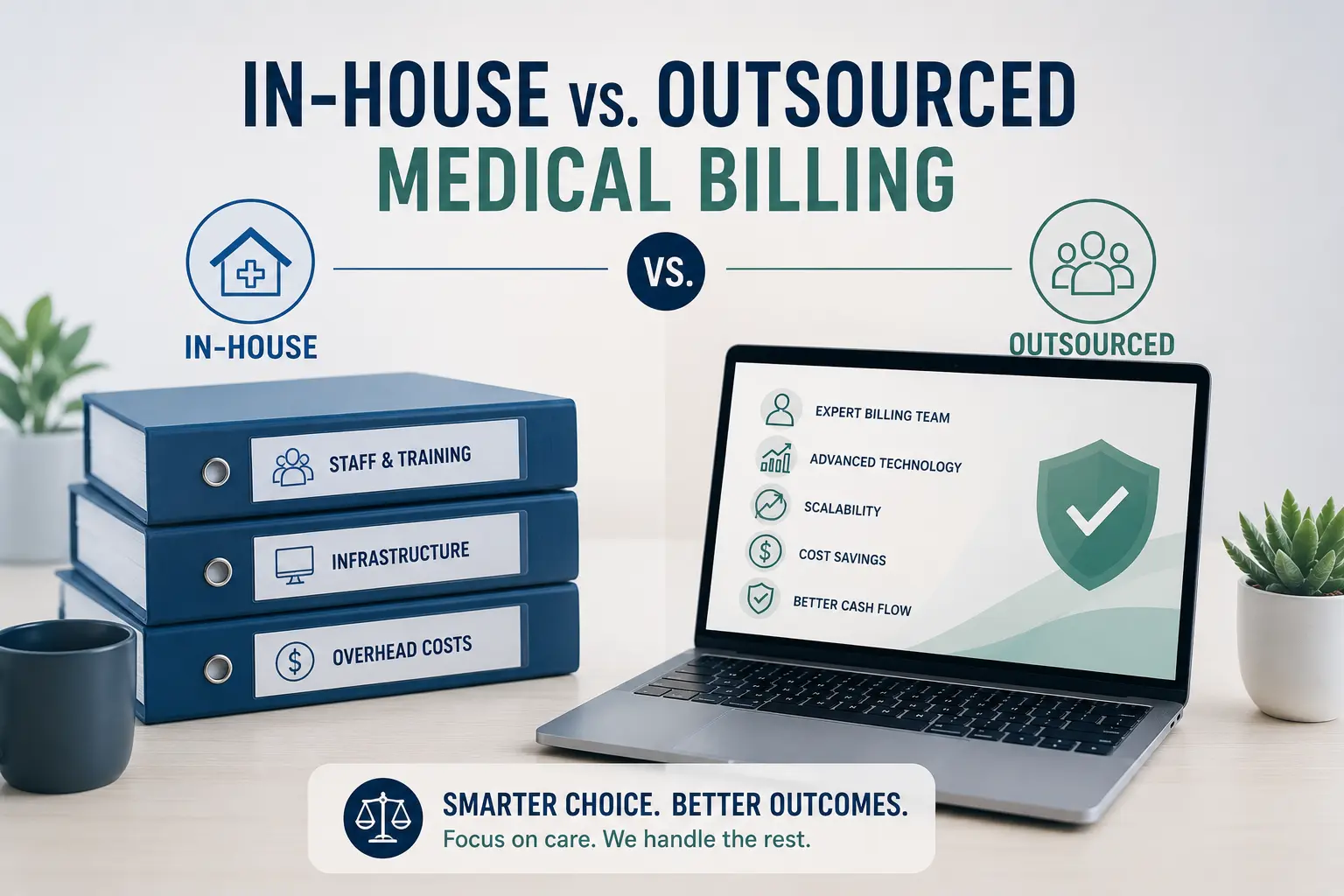
| In-House Billing | Outsourced Billing | |
|---|---|---|
| Cost structure | Fixed salary + benefits per FTE | Percentage of collections (typically 4–8%) |
| Denial capacity | Shared with new-claim workload | Dedicated function, built for volume |
| Specialty depth | Builds slowly, resets with turnover | Established across the account |
| Staffing risk | Understaffed as denial rate rises | Scales without a hiring cycle |
| Cost visibility | Salary line only; hidden costs elsewhere | Tied directly to what’s collected |
Questions to Ask Before You Decide
- What is the clinic’s actual denial rate today, and has it been tracked over the last twelve months?
- How many hours does the current billing team spend on appeals and resubmissions versus new claims each week?
- If the lead biller left tomorrow, how much backlog would surface immediately?
- Is the current staffing model sized for claim volume, or for claim volume and claim difficulty combined?
Final Thoughts
In-house billing isn’t automatically more expensive, and outsourcing isn’t automatically cheaper. What decides the real cost is how the model holds up once claims stop being simple, and behavioral health generates more non-simple claims than almost any other specialty. Clinics that size their staffing and their billing model around denial complexity, not just claim count, are the ones that avoid the AR backlogs that come with being under-resourced for the work actually in front of them.
Getting the staffing model right is only half the equation. The other half is whether that team has the capacity to respond when a payer opens an audit, which is where billing and clinical documentation have to work together under pressure. That’s the subject of our next piece.
See how CodeMax handles claims, denials, and appeals as one connected process →
Frequently Asked Questions
Not always. A clinic with a low, stable denial rate and an experienced in-house team may run close to cost parity. The gap widens as denial rate and claim complexity rise, since that's where in-house capacity gets stretched the most.
Most benchmarks put a workable initial denial rate at 5 to 10 percent, with anything above 15 percent signaling a systemic issue in authorization, verification, or documentation rather than a one-off billing mistake.
Transition timelines vary by payer mix and claim backlog, but most facilities plan for a multi-week onboarding period that includes credentialing verification, data transfer, and a parallel run before the outsourced team takes over claims fully.
Some facilities keep front-end functions like scheduling in-house while outsourcing claims submission and denial management specifically, since that's typically where the specialized capacity gap is largest.
This varies by clinic. Some redeploy billing staff into admissions or front-desk support roles where capacity is often also stretched, since those functions absorb overflow work when billing is under-resourced.