TL;DR: Reactive denial management fixes claims after they’ve already been denied. Preventive denial management stops the denial from happening. This piece covers:
Most behavioral health billing teams spend their time reacting: a claim goes out, comes back denied, and the team researches, corrects, and resubmits before the appeal window closes. That cycle keeps everyone busy, but busy isn’t the same as efficient. Every hour spent reworking a denied claim is an hour not spent submitting new ones, and the delay between the original date of service and final payment stretches longer every time a claim bounces back.
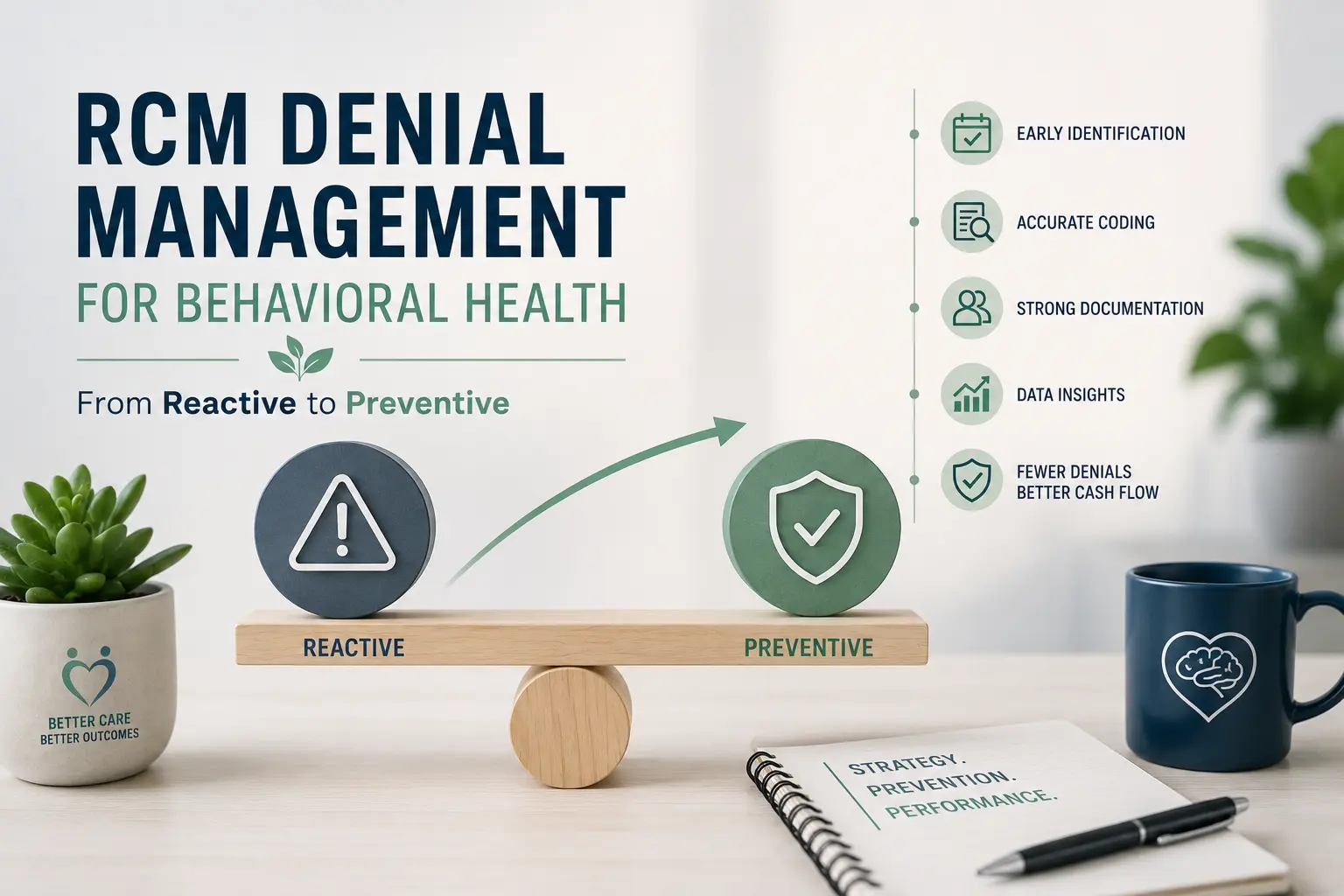
Preventive denial management means catching the issues that cause denials before a claim reaches the payer at all, rather than fixing them after a denial comes back. That includes real-time eligibility verification, confirming authorization matches the level of care being billed, and running claims through a scrubbing process before submission.
Why Reactive Denial Management Costs More Than It Saves
Reactive denial management treats each denial as an isolated event to be resolved rather than a signal pointing to something upstream. A claim denied for missing prior authorization gets corrected and resubmitted, but if the root cause, an authorization tracking gap, isn’t fixed, the next claim tied to that same client or that same payer hits the same wall. The rework cost compounds because the same mistake keeps generating new work instead of getting solved once.
What Preventive Denial Management Actually Looks Like
The shift from reactive to preventive isn’t a new piece of software. It’s a change in where the billing team’s attention goes: upstream, before a claim is filed, instead of downstream, after it’s denied. In practice that means verifying eligibility and benefits before the first session rather than assuming prior coverage still applies, confirming authorization is active and matches the level of care being billed, and scrubbing claims for coding mismatches or missing modifiers before they go out the door.
Common Behavioral Health Denial Triggers
Behavioral health claims carry denial risk that most other specialties don’t deal with at the same scale, which is a large part of why behavioral health billing operates by a different set of rules than general medical billing in the first place. A few triggers show up repeatedly:
- Eligibility mismatches: Behavioral health benefits are frequently carved out to a separate managed care organization, so a clinic can confirm medical coverage without catching that the behavioral health benefit requires its own verification.
- Authorization gaps at level-of-care transitions: Residential, PHP, and IOP each require their own authorization and concurrent review. A step-down in care that isn’t re-authorized breaks the billing chain even though the clinical transition was appropriate.
- Coordination of benefits errors: When a client has more than one payer, claims sent to the wrong payer first generate an avoidable denial.
- Time-based coding mismatches: Codes like 90837 and 90834 are tied to documented session length. A note that doesn’t match the billed code’s time threshold is an easy denial to prevent and a costly one to catch after the fact.
Building a Preventive Workflow Into the Revenue Cycle
A preventive workflow puts structure around these triggers instead of catching them claim by claim. Front-end verification needs to be built into the admissions process itself, not treated as a step someone gets to when time allows. Claim scrubbing rules need to reflect behavioral health-specific coding and modifier logic, not a generic medical billing template. And for clinics treating substance use disorders, 42 CFR Part 2 adds a layer that has to be accounted for before a claim goes out, since the records supporting that claim can’t move through a billing system the same way a standard treatment note does.
| Reactive Approach | Preventive Approach |
|---|---|
| Denial triggers rework after submission | Verification happens before submission |
| Root cause often goes unaddressed | Denial trends tracked to fix upstream issues |
| Success measured by appeals won | Success measured by first-pass acceptance |
| Authorization checked when a claim is denied | Authorization confirmed at each level-of-care change |
What to Measure to Know It’s Working
A preventive approach is only as good as what a clinic tracks to confirm it’s working. First-pass claim acceptance rate matters more than total collections, since it shows how many claims are getting paid without ever touching a denial or appeal. Denial rate should be tracked by payer and by level of care, since a facility running residential and outpatient programs side by side often finds the two carry very different denial profiles, frequently tied to how continued stay is justified against ASAM placement criteria during utilization review. Reviewing these numbers monthly, rather than annually, is what lets a clinic catch a shift in a payer’s documentation requirements in weeks instead of after a quarter’s worth of denials has already piled up.
Final Thoughts
The cost of staying reactive isn’t just the rework itself. It’s the revenue that never gets fully recovered and the staff time that never gets reinvested into growth. A preventive model shows up in cleaner claims, faster payment, and a billing team spending its time on new revenue instead of chasing old denials.
See how CodeMax builds denial prevention into behavioral health billing and claims management →
Frequently Asked Questions
Most clinics see first-pass acceptance rates improve within one to two billing cycles, though full impact on days in AR typically takes longer since it depends on clearing the existing denial backlog first.
Real-time eligibility verification tools, claim scrubbing rules built for behavioral health codes and modifiers, and a reporting dashboard that tracks denial reasons by payer are the core components. The tool matters less than whether the workflow around it is actually preventive rather than reactive.
No. Denials trace back to several distinct root causes, including eligibility gaps, authorization timing, coordination of benefits errors, and coding mismatches, in addition to documentation. Sorting denials by reason code before assuming the cause is the more reliable diagnostic step.
A rate in the 92 to 95 percent range is generally considered workable for behavioral health facilities, with anything meaningfully below that indicating a gap somewhere upstream of billing, usually verification, authorization, or coding.
Not necessarily. Some clinics get meaningful improvement just by restructuring workflow and responsibility, such as moving eligibility verification earlier in the admissions process, before adding new technology.