Key Takeaways: The revenue behavioral health facilities most often lose sits in claims already marked closed: underpaid, written off, or adjusted to zero. AR recovery goes back through those claims, and because payer deadlines keep moving, the sooner it happens the more can still be collected.
- AR follow-up works open claims. AR recovery reviews claims the system already treats as resolved.
- A claim reading as paid is not the same as a claim paid correctly, and the difference is invisible without comparing the payment to the contract.
- Single case agreement claims processed as standard out-of-network are a common source of underpayment.
- Small underpayments repeated across many claims from one payer are where most recoverable value tends to sit.
- Recovery runs on timely filing and appeal windows, so recent closed claims usually carry the most recoverable value.
Most facilities think of unpaid claims as the ones still open on the aging report. Those are the claims someone is chasing.
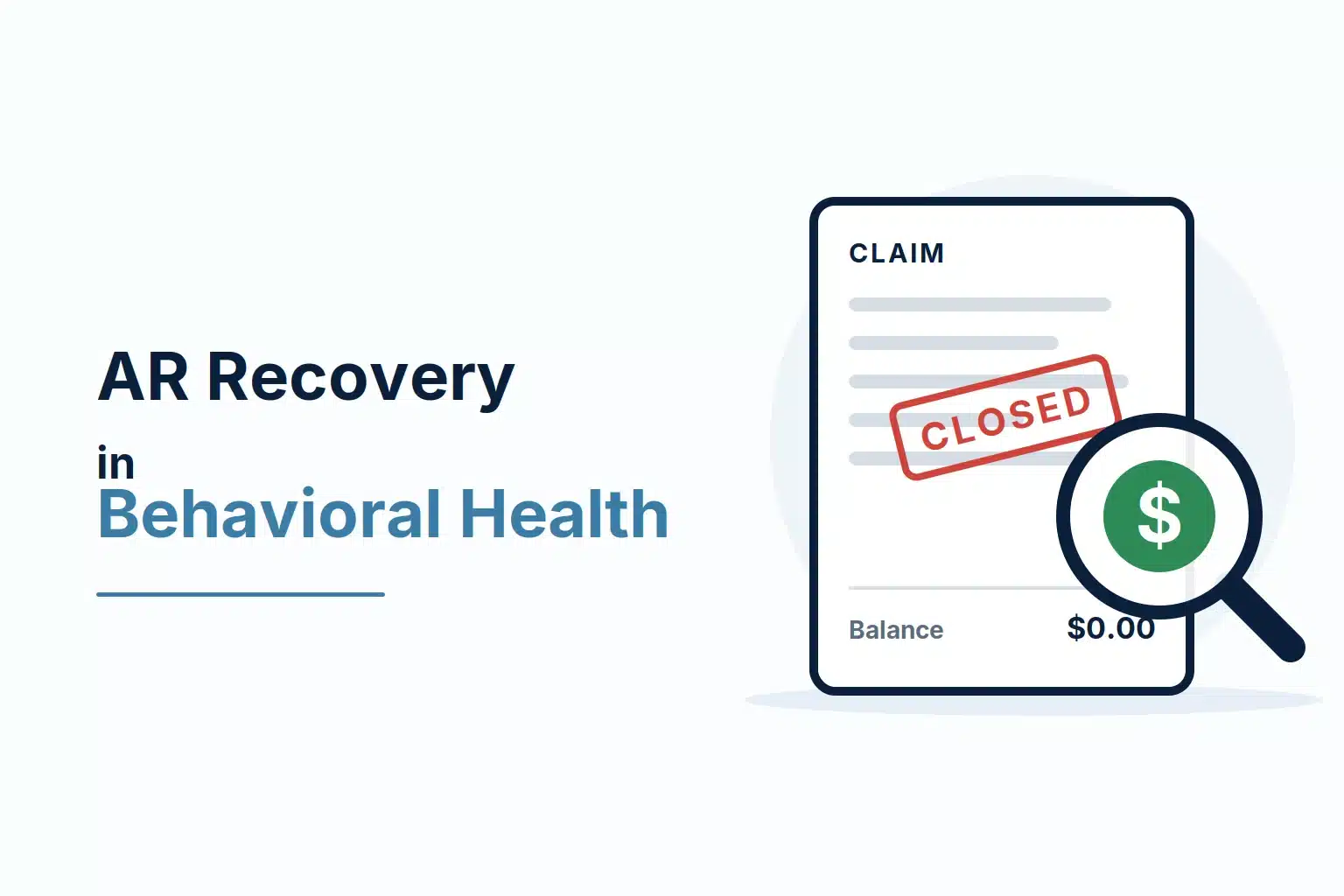
The revenue that is easiest to lose is somewhere else. It sits in claims that are already marked closed: paid for less than they should have been, denied and written off, or adjusted to a zero balance and never looked at again. Nobody is chasing those claims, because as far as the system is concerned, there is nothing left to chase.
AR recovery is the retrospective review of claims that have already been closed, paid, or written off, to find revenue that should have been collected but was not. It focuses on underpaid claims, denials that were written off instead of appealed, and balances that were adjusted away. It is sometimes called a zero-balance review or forensic billing.
It is different from ordinary AR follow-up, and the difference is exactly why the money it finds is so often overlooked.
AR recovery versus AR follow-up
Both are about collecting money, but they look in opposite directions.
| Question | AR follow-up | AR recovery |
|---|---|---|
| Looks at | Open claims not yet paid | Claims already closed, paid, or written off |
| Question it asks | Why hasn’t this claim paid yet? | Should this claim have paid more, or at all? |
| Where it happens | The aging report | Closed and zero-balance accounts |
| Why claims get missed | Nobody followed up in time | Nobody knew there was anything left |
AR follow-up works the claims a facility already knows about. We covered how to work those in our piece on aged receivables and AR aging. AR recovery goes after the claims a facility has stopped thinking about. That is what makes it valuable. The revenue it finds has usually been counted as already handled.
Where recoverable revenue hides
In behavioral health billing, recoverable revenue tends to collect in a few predictable places.
- Claims paid below the contracted rate: A claim pays, the balance goes to zero, and it looks resolved. But the payer allowed less than the contract says it should have. Unless someone compares the allowed amount against the contracted rate, the underpayment is invisible, because the claim reads as paid.
- Single case agreement claims paid at the wrong rate: A claim covered by a single case agreement can process as standard out-of-network and pay far less than the agreed rate. The claim closes, and the difference is never recovered unless someone checks the payment against the agreement.
- Denials that were written off instead of appealed: A denial arrives, it looks like too much work to fight, and the balance gets adjusted off. Some of those denials were for fixable reasons, like a missing authorization number, a coding error, or a documentation gap that could have been corrected and appealed.
- Small balances adjusted away: Individually, a small underpayment is not worth an hour of someone’s time. Across hundreds of claims, the same small underpayment repeated becomes real money, and it often traces back to one payer applying the wrong rate consistently.
- Contractual adjustments applied incorrectly: A contractual adjustment reduces a balance to what the contract allows. If it is applied wrong, it reduces the balance more than it should, and the lost amount disappears into what looks like a routine write-down.
The common thread is that none of these show up as a problem. They all look like closed claims.
Why this revenue gets lost
AR recovery finds money that was lost for understandable reasons, and understanding them explains why it keeps happening.
- Volume: Billing teams are busy working open claims. Going back through claims that already closed is rarely anyone’s priority, because the open claims feel more urgent.
- Paid does not mean paid correctly: Most billing workflows treat a paid claim as done. Checking whether it paid the right amount is a separate step that often does not exist.
- No one reconciles against the contract: To find an underpayment, someone has to know what the claim should have paid. That requires comparing payments against contracted rates, which many facilities do not do routinely.
- Small balances do not feel worth it: Chasing a single small underpayment is hard to justify. The pattern across many claims is what matters, and patterns are only visible when someone looks for them.
The deadline problem
This is the part that makes AR recovery time-sensitive.
Recovery is not open-ended. Payers set limits on how long after a date of service a corrected claim or an appeal can be submitted, and those limits vary by payer and by contract. A claim that was underpaid eight months ago may still be recoverable. The same claim two years later may be past every deadline, no matter how clearly it was underpaid.
That means the value of a recovery review shrinks the longer it waits. Each month that passes moves more claims past their deadlines. The claims most worth recovering are usually the recent ones, which are still inside their windows.
How AR recovery works in practice
A structured recovery review usually follows a clear sequence.
- Start with a sample: Rather than reviewing every closed claim, pull a representative sample by payer and by level of care. The sample shows where the problems are concentrated.
- Look for patterns: One underpaid claim is an error. The same underpayment across many claims from one payer is a pattern, and patterns are where most of the recoverable value sits.
- Compare payments to contracts: For each payer, check whether allowed amounts match contracted rates, and whether single case agreement claims paid at the agreed rate.
- Check written-off denials: Review denials that were adjusted off, and identify which were for correctable reasons and are still inside their appeal windows.
- Prioritize by deadline, then value: Claims closest to their filing or appeal deadlines come first. Among the rest, the largest recoverable amounts come next.
- Fix the cause going forward: A recovery review that finds the same underpayment repeating has found a process gap. Recovering the past claims is only half the value. Stopping the pattern is the other half, and it is what keeps the same revenue from being lost again next quarter.
Final Thoughts
The claims a facility is actively chasing are rarely where the most revenue is lost. It is lost in claims already marked closed: underpaid, written off, or adjusted to zero, and then forgotten because the system says there is nothing left.
AR recovery goes back and checks. The revenue it finds is often money the facility had already written off without realizing it was still recoverable. And because recovery runs on deadlines, the sooner a review happens, the more of it can still be collected.
Has your facility ever reviewed its closed claims against its contracts? Request a revenue cycle audit to find underpayments and written-off denials that are still inside their deadlines, or learn about our billing and claims management. Call 866-263-3629 or email info@codemaxmb.com.
You can also speak to a specialist about a closed-claims review.