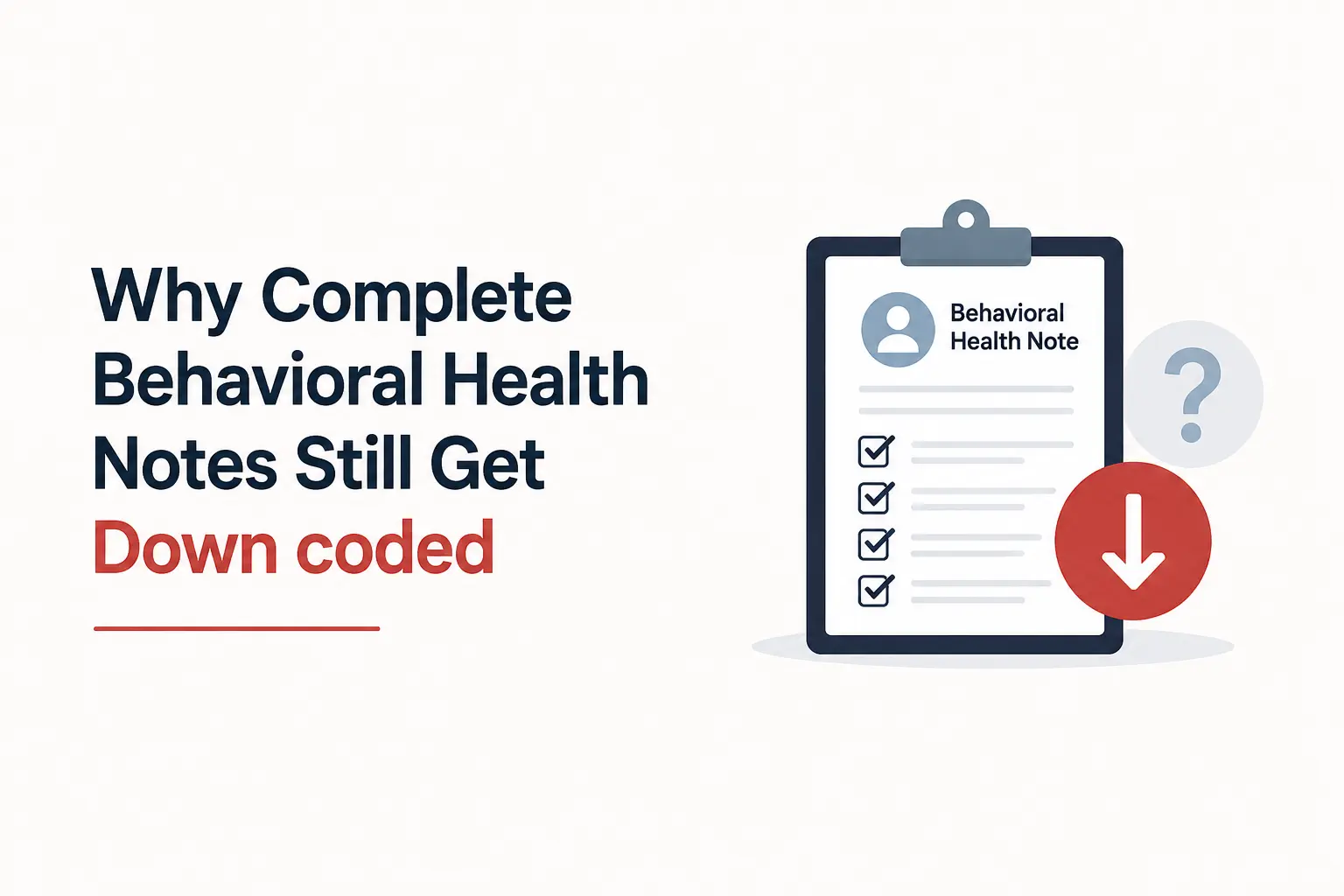
Key Takeaways: Complete behavioral health notes still get downcoded because payers grade documentation against medical necessity criteria sets the facility cannot see and cannot confirm by asking.
- Payers apply ASAM, MCG, InterQual, or state-specific criteria, and the set being used is never printed on the denial.
- ASAM Fourth Edition adoption varies by state, with Washington delayed to January 2028 while other states remained on the Third Edition.
- Payers do not confirm which edition they apply over the phone, and published bulletins are not binding on them.
- Residential, IOP, and PHP each fail differently: level-of-care language, treatment plan linkage, and individual engagement inside group notes.
- Occasional downcodes point to a documentation problem, frequent downcodes point to a broader revenue cycle problem.
Contents
Your clinicians are documenting. Your EHR flags nothing. Your notes contain every element the template asks for. And your claims keep coming back downcoded to a lower level of care.
This is one of the most common places behavioral health revenue leaks, and it is almost never a documentation effort problem. It is a documentation alignment problem. The notes are complete. They are just not written against the criteria the payer is actually using to review them.
Clinical documentation improvement (CDI) in behavioral health is the process of aligning clinical records with the specific medical necessity criteria a payer uses to authorize and reimburse a level of care. Unlike general CDI, behavioral health CDI depends on knowing which criteria set governs the claim, because a note that satisfies one framework can fail another.
That last point is where the money is lost, and it is worth understanding in detail.
The criteria set nobody tells you about
When a payer reviews a residential, PHP, or IOP claim for medical necessity, they are checking the documentation against a specific clinical framework. In behavioral health, that framework is usually one of the following:
- The ASAM Criteria, published by the American Society of Addiction Medicine, which sets placement and continued stay standards for substance use disorder treatment
- MCG, formerly Milliman Care Guidelines, a proprietary set of evidence-based care guidelines licensed to payers
- InterQual, a competing proprietary criteria set owned by Optum
- State-specific criteria, which some Medicaid programs and state agencies mandate in place of, or alongside, the above
A note written to satisfy one of these can fall short against another. The clinical care may be identical. The documentation may be thorough. But if the reviewer is checking for elements that the note does not surface in the way that framework expects, the claim gets downcoded or denied.
Facilities rarely discover this on their own, because the criteria set being applied is not printed on the denial.
The ASAM edition problem
The clearest example of this is the ongoing transition between editions of The ASAM Criteria.
The American Society of Addiction Medicine released the Fourth Edition of The ASAM Criteria for adults in October 2023. It was a substantial revision. It introduced a new dimension, removed a level from the specialty continuum, and replaced the episodic treatment framework with a chronic care model.
Here is the part that costs facilities money. ASAM’s own guidance states that states and payers are adopting the Fourth Edition at varying rates, and that certain jurisdictions may still be implementing older versions.
That variability is not a rounding error. It is measured in years:
Washington State delayed its adoption date to January 2028 after SB 5361 passed in the 2025 legislative session. At the time of ASAM’s implementation webinar, Kentucky was the only state to have formally adopted the Fourth Edition, effective June 25, 2025, and Medicaid contracts with Optum in other states remained based on the Third Edition. Louisiana’s Department of Health, with assistance from Milliman, opened a review of the transition from the Third Edition to the Fourth.
So a facility treating patients across three states may be documenting against three different editions at the same time, without knowing it. Every one of those editions changes what a utilization management reviewer expects to see.
In our experience, payers do not answer this question over the phone. Some publish bulletins announcing a planned transition date from the Third to the Fourth Edition. But a published bulletin is not a binding commitment. Payers are not bound by their own notice, and they are not obligated to inform providers when they actually switch over.
That means a facility can be documenting correctly to the Third Edition on Monday, and be reviewed against the Fourth Edition on Friday, with no notification in between and no change in the quality of care delivered.
MCG and InterQual add a second layer
The commercial side of the problem works similarly, with an additional complication.
Many payers license both MCG and InterQual. Both are proprietary. Both are used for level of care determinations. And when a facility submits a claim, it is frequently not clear which of the two will be used as the level of care reference for that specific review.
The practical consequence is the same as the ASAM edition problem. Documentation is being graded against a rubric the facility cannot see and cannot reliably identify by asking.
This is not an argument for learning both frameworks. Most clinical teams do not have the bandwidth, and knowing the frameworks in the abstract does not tell you which one applies to the claim in front of you. It is an argument for knowing, payer by payer and contract by contract, what is actually being applied.
Three scenarios where this shows up
These are the patterns that appear most often in behavioral health revenue cycle work.
| Scenario | What the facility sees | What is actually happening |
|---|---|---|
| Residential downcode | H0018 residential claims paid at a lower level of care | Medical necessity language in the notes does not match the criteria set the payer applied |
| IOP prepayment review | H0015 claims held for records before payment | Progress notes describe treatment activities but do not tie them back to treatment plan goals |
| PHP group therapy challenge | H0035 or S0201 per diem claims questioned or partially denied | Group notes document the group, not the individual patient’s clinical engagement within it |
Residential care downcoded to a lower level
A residential program bills H0018 and receives payment at a lower level of care. The clinical team reviews the chart and finds nothing missing. Every required field is populated.
The gap is in how medical necessity is expressed. The documentation demonstrates that the patient needs treatment. It does not demonstrate, in the specific terms the applied criteria set requires, why the patient needs treatment at that intensity rather than one step down. Those are different arguments, and only one of them protects the per diem rate.
IOP claims held for prepayment review
An intensive outpatient program billing H0015 starts seeing claims held for records before payment. This is one of the more common failure points in IOP billing. The progress notes are detailed. Clinicians are writing thorough descriptions of each session.
The problem is that the notes describe what happened without connecting it to why it was necessary. A note that records the intervention delivered, but does not reference the treatment plan goal it advances or the measurable progress toward it, reads to a reviewer as activity without justification. Detail is not the same as defensibility.
PHP group therapy documentation
A partial hospitalization program bills H0035 or S0201 per diem, with group psychotherapy under 90853 as a core component, following standard behavioral health billing guidelines. Claims start getting questioned, or the authorized level of care is challenged as not matching what was delivered.
The documentation records the group session, the topic, the modality, and the duration. What it does not record is each individual patient’s clinical participation, response, and progress within that group. From a reviewer’s position, a note that could describe any patient in the room does not establish medical necessity for a specific patient. When billed services do not clearly match what was authorized, denial codes indicating an authorization mismatch follow.
How this becomes prepayment review
Downcoding and denials are the visible symptom. Prepayment review is the escalation.
When a payer’s pattern analysis flags a facility for repeated medical necessity issues, claims stop being paid on submission and start requiring records first. Cash flow changes immediately. A facility that was collecting on a predictable cycle is suddenly waiting on manual review for every claim, with staff time diverted to records requests. Without clear financial reporting, the shift often shows up in the bank balance before anyone identifies the cause.
Some markets see this sooner than others. Facilities operating in states with heightened billing scrutiny tend to hit pattern thresholds faster.
The important thing to understand is that prepayment review is usually the end of a documentation problem that has been running for months. The claims that triggered it were submitted long before the review started. Exiting prepayment review is a separate process with its own requirements, and it is not something a facility resolves by simply writing better notes going forward.
What actually fixes this
The fix is not a documentation template. Templates standardize what clinicians write, which is useful, but a template written against the wrong criteria set produces consistently wrong notes.
The fix starts with identifying which criteria set, and which edition of it, each of your payers is applying to each level of care you bill. That mapping is what turns documentation from a clinical exercise into a defensible reimbursement position. It is also the part facilities cannot easily do alone, because payers do not volunteer the information and are not required to.
Once that mapping exists, documentation standards can be built against it, and clinical teams can be trained on the specific language and structure that survives review for the payers that actually matter to the facility’s payer mix.
One caveat matters here, and it is the difference between a facility that fixes this and one that keeps paying for it. Occasional downcodes point to a documentation problem. Frequent downcodes usually point to something wider. If a meaningful share of claims are being reduced or held across multiple payers and multiple levels of care, documentation is likely one symptom of a broader revenue cycle management issue, and a documentation-only fix will underperform. In that situation the useful first step is a full RCM audit that identifies where the revenue is actually being lost, rather than assuming the notes are the whole story.
Final Thoughts
Where a facility should start depends on how often this is already happening.
If downcodes are frequent, or you are already on prepayment review, the problem has usually spread beyond documentation. Multiple payers reducing multiple levels of care points to a revenue cycle issue with several contributing causes, and fixing the notes alone will not recover what is being lost. The right first step is a full audit that identifies every point where revenue is leaving the cycle. CodeMax consulting audits each stage of the revenue cycle and rebuilds the weakest ones first, and brings in ASAM-certified physicians to identify gaps in utilization review.
If this has not happened to you yet, and you want to keep it that way, the work is preventive. RevGuard is our clinical documentation quality assurance service, built to manage these issues proactively and keep facilities off prepayment review and out of downcoding in the first place.
Not sure which one you need? Start with a revenue cycle audit if claims are already being reduced or held, or learn how RevGuard quality assurance keeps documentation defensible before claims go out. Call 866-263-3629 or email info@codemaxmb.com.
You can also speak to a specialist about which starting point fits your situation.
Frequently Asked Questions
Payers generally do not answer this question over the phone. Some publish bulletins with planned transition dates from the Third to the Fourth Edition, but those notices are not binding, and payers are not obligated to notify providers when they switch. Determining the operative edition requires working through payer contracts, published policy, and observed adjudication patterns rather than a single phone call.
They are related but distinct. A documentation audit reviews a sample of records against a standard and reports findings. Clinical documentation improvement is the ongoing process of changing how documentation is produced so that it aligns with the criteria being applied. An audit identifies the gap. CDI closes it.
Improved documentation is necessary but generally not sufficient on its own. Prepayment review is triggered by historical claim patterns, and exiting it typically involves demonstrating sustained compliance over a defined period alongside direct engagement with the payer. Documentation quality assurance is most effective as a preventive measure, keeping a facility out of prepayment review in the first place. A facility already in prepayment review usually needs a broader revenue cycle review to identify everything contributing to the pattern.
Completeness and defensibility are different standards. A note can contain every element an EHR template requires and still fail to establish, in the terms the applied criteria set uses, why the patient requires that specific level of care rather than a lower one. Reviewers assess the second question, not the first.
Yes. ASAM criteria govern substance use disorder placement, but mental health levels of care billed under codes such as H0035 for partial hospitalization or S9480 for psychiatric intensive outpatient are reviewed against MCG, InterQual, or state-specific criteria. The mismatch problem is the same.
A clinical documentation quality assurance service reviews notes on an ongoing basis, before claims go out, to confirm they support the level of care being billed. Its purpose is prevention. An RCM audit is a point-in-time review of the entire revenue cycle, including coding, authorization, claim submission, denials, and collections, to locate where revenue is being lost. Facilities that are already experiencing frequent downcodes generally need the audit first, because the cause is often distributed across several parts of the cycle rather than concentrated in documentation.